Saturday, May 30, 2015

Book Review: The New Digital Age

I have been reading this 250 page book called "The New Digital Age: Transforming Nations, Businesses, and Our Lives" for a while now. In between took up two other books and wrapped them up! Finally finished it today guess mainly because I have this OCD tendency to complete reading all the books I pick up. Now that I am done, I am trying to recall what new ideas I picked up and nothing much comes to mind! This is sad.

Book is written by Eric Schmidt and Jared Cohen and came out two years back. They both have interesting backgrounds. Schmidt was the CEO of Google from 2001 to 2011 and is currently the Executive Chairman of Google. Cohen is the Director of Google Ideas and Senior Fellow at the Council on Foreign Relations, etc. With this background, I thought they will deliver extremely insightful views on how the the digital revolution is/will change the world. They have put together some six chapters all of which are titled as "The Future of xyz", with xyz replaced by States, Revolution, Terrorism, Conflicts, Reconstruction, etc. These are all interesting areas to explore from the Digital Age perspective. But there is no new vision or insight anywhere to be found. If you have been watching the news, reading magazines over the last decade, you'd know pretty much all the superficial things they have stated. Occasionally some parts where they are talking about isolating parts of the cyberspace that are contaminated into quarantine (similar to what we do in real-world to isolate terrorism sponsoring national entities or spread of a disease), issuing digital visas to visit parts of the net in future, etc. might be new/interesting to some readers or policy makers. But I had a hard time finding many such examples. They also have played it very safe so that they are not angering US Govt (they are against WikiLeaks, etc.) that might jeopardize their own future careers. Might be a good idea from their personal career point of view but it makes the book read more like a US Govt report rather than an insightful analysis of outsiders.

I guess enough said. I will keep it short this time. :-)
-sundar.

Book Reviews: Innovator's Dilemma & Jugaad Innovation

Few weeks back when we went on a week long vacation, I packed "Jugaad Innovation - A Frugal and Flexible Approach to Innovation for the 21st Century" by N. Radjou, J. Prabhu & S. Ahuja as a possible lite read. When we were leaving for the airport from my SIL's home after a bit of repacking, I couldn't locate the book. Since I figured it didn't make sense to head out without any reading material, grabbed "The Innovator's Dilemma: When New Technologies Cause Great Firms to Fail" by Clayton Christensen from my SIL's home book shelf. By the time we boarded the plane, located the first book as well. This turned to be a blessing in disguise since both books were of the lite variety and were quite related to each other in their content. So, before the vacation was over, I could read the older Innovator's Dilemma (ID) first and then finish more than half of the Jugaad book that dove tailed into the first one nicely. Whenever I saw book reviews on The Economist magazine that often discussed two books together, I used to wonder how they found two different books that came out around the same time that are so closely related. Used to brush that thought aside thinking that topic must be the current fad inspiring multiple people to write books. Though these two books were published more than 10 years apart, serendipity had me reading them back to back in the same week. So, here I am talking about them together.

The ID book is more than 17 years old and is sort of a classic since the thoughts put forth in the book were new in the late 90's. By now the ideas are part of the common business wisdom. But are still plausible threats to existing large businesses. Main ideas presented can be summed up in these three bullets:

  • Often when disruptive new ideas or technologies bring in new products to market, customers using older products won't know what to do with the new products (since they may not match their present needs nicely). But the other advantages such as cost, portability, ease of use may help other customers pick it up. Once the market grows, the cheaper, newer alternative can eat into the main market.
  • Established companies who pay all the attention to existing customers taking care of all their needs with evolutionary products may miss this change in the market place and may end up on the side lines while new companies move in and start eating their lunch.
  • Established companies should not try to manage this dilemma by trying to do both old and new products with one set of development & marketing teams since the messages/market may be contradicting each other. Instead, they should establish a subsidiary or a standalone group with its own development, marketing teams and P&L center. If the idea succeeds, it can eventually be mainlined.
About one fourth of the book talks about hard drive development by famous tech companies in the 60's to 90's and how despite having the right new product that is quite different from the current crop of products, those companies repeatedly failed to capture the market losing out to new comers. This is due to the fact that the new products are of no interest to their existing customers. For example, a much smaller and cheaper drive that is is slightly slower may not be of interest to the top end computer maker. So, the drive maker puts this product on the shelf and goes back to making incremental improvements to their existing form factor drives to suit the needs of the their customers, as they were taught to in the business school. But a new company starts selling the smaller, cheaper, slower drives to a totally new market such as game consoles. As their sales volume increases, they manage to make the drives faster and thus eat into the high end market due to lower price and smaller form factor. 

Author spends so many pages and charts to convey this idea. While all the charts and tables are important for his analysis, I am not sure it contributes a lot to the book's message. A good editor could have trimmed it down considerably. He then moves on to point out similar slips occurring in very different industries such as earth moving equipment manufacturers. Overall idea is certainly quite important for large enterprises. I was quite amused to see the last chapter where the author discusses how automobile manufacturers should handle the vexing problem of developing and marketing an electric car. Based on all the ideas discussed in the book, the author suggests developing a cheap car, and finding a market that can use a slow car that will drive only about 100 miles between recharging which may take hours. But in the last ten years, Tesla Motors has been doing very well by designing high performance electric cars that drive 300+ miles between charges and are extremely expensive! 

That takes me to the Jugaad book. A friend of mine bought this book as a present to my son when we were in India one year back. It came out only in 2013 when the idea of Jugaad had been raising rapidly becoming a course in Harvard Business School, being talked about as Frugal Engineering by characters like Carlos Ghosn (Nissan CEO) and so forth. In Hindi, the term means improvising something cheap to take care of the local need. 

The three authors have provided a large number of examples and case studies illustrating how R&D conducted in economically poorer societies to develop products and services to meet the local needs have been making tremendous progress in bringing costs down despite being high quality products. These products are then sold back to affluent societies as well! This is very different from last century's model of taking an expensive product with bells & whistles developed for richer societies and then stripping it down to make a cheaper version for poor countries. Often such stripped down versions don't even work well in the targeted markets since the atmospheric conditions, usage models are all quite different compared to the original markets. 

In general most well known consumer products (cars, phones, food items, medicines, appliances) or even industrial products (heavy equipment, MRI machines) & services (banking, manufacturing) that we usually hear about  seems to be coming out of the US or Western Europe companies. So, one might be easily lead to think that other nations such as India don't seem to do much of innovation. This books dispels that myth pointing out to all the new products and services that are being developed and sold in countries like India, Brazil and China at often less than one tenth of the price making them affordable to not only local communities but also to poorer countries around the world first and then to US and Western Europe's affluent societies next. Examples range from an infant baby warmer (a simpler model developed by a woman pediatrician in India that costs <$100 vs. $3000 model sold by GE) to selling solar panels not as a product but more as a service in Brazil. Authors have tried to break down the Jugaad idea into 6 steps, such as 

  • Seek opportunity in adversity: e.g. http://www.mitticool.in/ that is selling refrigerators that work without electricity.
  • Do more with less: e.g. An Argentina farmer that invented the idea of asset light farming to overcome difficulties in owning land, equipment, labor needed for farming and is able to scale this model up now.
  • Include the margins, meaning bring in the resource poor consumers who still need various products and services by making them extremely affordable, easily available using existing infrastructure.
  • Think and act flexibly, meaning get early models out in the open and be ready to change the product/business model if the first idea fails. Doing this early/quickly limits losses.
  • Keep it simple
  • Follow your heart, since strict focus group study and ivory tower R&D may not be always right. Innovators living in the actual society/atmosphere where the product is going to be used may have a better understanding of the actual need.

Apparently Western companies such as Phillips, Ericsson, Pepsi, GE, Nissan, etc. are all learning these ideas and implementing them successfully. You can search YouTube with the term Jugaad and can see literally 100s of Jugaad examples. Most of those may look funny and sad at the same time making us realize how people around the world get by with so little so cheerfully. Still, the ideas can be extended to big and complicated projects as well. I remember reading how ISRO (Indian Space Research Organization) just dug a one foot deep trench with a 1KM radius around the launching pad that turned out to be a simple solution to route lot of cables easily while protecting them from the heat of the launching pad. When the Prime Minister of India quipped last year that the Mars probe they launched successfully cost less than what was spent to produce the movie Gravity, I was able to make that connection. :-)

Naturally, variations of this concept is in practice in various societies. (If you haven't heard of a Liter or Light, see this site: http://literoflight.org/#/) But this book particularly being centered on India, with all the numbers listed in Crores (i.e. Indian equivalent of 10 Million) and money in Indian Rupees (instead of US dollars), sounded quite different since I am so used to US being the center of the universe all the time! :-)

In the last chapter, they have managed to cover themselves saying Jugaad is not the next great thing after sliced bread that will eliminate hunger and bring world peace but is a complementary model for R&D that should be part of an organization's overall MO. Authors have setup a website that is supposed to bring all the related material together and is promoted in the book quite a bit. But I found the site quite disappointing when I visited. I also found the innumerable subsection titles that appear once every two paragraph a bit annoying. Still, this book as well as the ID book, both are easy reads and should be worthy of your time if you choose to pick them up.
-sundar.

Sunday, February 1, 2015

Book Review: Quirkology by Wiseman

If you want to arm yourself with fun facts before attending a dinner party to ensure lively conversation, Quirkology: How we discover big truths in small things by Richard Wiseman might be a delightful choice. It is of the academic lite variety that uses very simple/accessible prose any high school child can easily read. Author, who is a professor in UK, discusses tons and tons of social, behavioral experiments scientists have conducted allover the world to answer unusual questions, with the author himself being one of those researchers.

It starts off asking the readers to write an imaginary Q on their forehead with their index finger. Later the author reveals that those who wrote the Q such a way that the little line at the bottom reaches the right eyebrow (i.e. they can read the Q themselves correctly) is a bit more self-centered introverts who are not good liers while those took it to their left eye brow (i.e. Q looks correct to others looking at them) is more open, concerned about others and are better liers! Author talks about a range of experiments of this kind that measure or try to understand a lot of quirkiness embedded in the behavior of human beings. This includes figuring out how many people it takes to start a Mexican wave in a football stadium, perceived personality traits of fruits and vegetable (lemons are seen as dislikable, onions as stupid, etc.), discovering that the children’s drawing of Santa Clause grow larger in the build-up to Christmas Day and shrink in January and so forth! The quote at the beginning saying “What is the use of such a study? The criticism implied in this question has never bothered me, for any activity seems to be of value if it satisfied curiosity, stimulates ideas, and gives a new slant to our understanding of the social world” by Stanley Milgram. Fair enough.

It is written mostly like a report of a series of experiments conducted to understand such quirkiness. Some things I would have figured impossible to measure have lead to some serious large scale testing. A good example is determining what is the world’s funniest joke. How would you go about designing an objective experiment for this? Wiseman setup a website, got enough publicity and asked people to contribute jokes and rate the ones on the site. He eventually got a collection of about 40,000 jokes and 1.5 million ratings. You can still visit this site to read jokes and look at several fun facts related to creating jokes here (length of funniest jokes are 103 words, if you want to tell an animal joke, make it a duck). Though it is an interesting experiment that got a Guinness record citation and a lot of attention, despite presenting most liked joke in US and outside US, it still concluded that there may not be just one joke that is the funniest but what makes people laugh is quite subjective. Still I liked the scientific approach/analysis to this question that resulted in a lot of interesting insights. One insight obtained via brain scans is that the left hemisphere sets up the initial context for the joke and then a small area in the right provides the skill needed to appreciate the punch line! So, patients who have had some damage to their right hemisphere are not able to understand jokes well and don’t see the funny side of life much. Example is this joke. A man goes up to a lady to ask “Excuse me, Have you seen a policeman around?”, the lady says no. Then three potential punch lines are provided to the listener asking them to choose one they consider will make a good joke:
1. OK, give me your watch and necklace then..
2. OK, it is just that I have been looking for one for half an hour.
3. Baseball is my favorite sport.
People with right hemisphere brain damage choose 3 since they don’t get the joke implied in 1 but understand the "punch line grammar" that it should be quite different from the setup!

There were really interesting studies related to circadian rhythms (a scientist who had to live 375 feet underground for two months did it without clocks/access to sunlight and thought only 34 days had passed!), how people born in the summer are luckier, effects of tax rate on people's date of birth/death, psychology of magic/seance room, decision making (people will go home and come back next day to avail a sale to save $15 if the product costs $20 but won't if it is a $2000 product), effects of people's name in their career, factors governing tipping/donations, racism, female van drivers being the ones taking more than 10 items through the "10 items or less" line in the grocery store and many more.

One very simple study conducted in the 1960s by Stanley Milgram involved dropping hundreds of postage paid envelopes addressed to "Friends of the Nazi Party" or "Friends of Children's Hospital" on the first line with everything else remaining the same. Whoever finds it may drop it off in the mail box or throw it in trash. Counting how many envelopes got mailed and how many didn't, gave an indication of how people felt about Nazi party and Children's hospital in that town. This turned out to be a very effective way of taking a poll rather than asking people the same question that produced unreliable results. This technique is still used today to decipher how people feel about Gays & Lesbians, Arab-Israeli issues, Bill Clinton's impeachment and so on all over the world. Quite neat.

The author himself acknowledges how useful these factoids will be to liven a dinner party and lists the 10 best items from his list. The best one? People would rather wear a sweater that has been dropped in dog feces and not washed than one that has been dry cleaned but used to belong to a mass murderer!! :-)

Give it a whirl.
-sundar.

Saturday, January 31, 2015

Book Review: Empires of Food

I picked up Empires of Food: Feast, Famine, and the Rise and Fall of Civilizations by Evan Fraser and Andrew Rimas while randomly browsing a book store. It's been on the shelf for couple of years and so finally picked it up. A while back I saw a Hollywood movie called Push, in which certain characters in the story are able to instill (or "push") memories into other people's minds, making them truly believe with vivid recollection a life, family, friends they had, which in reality they never did. That movie didn't do well in the box office. Reason is that while the concept is brilliant, execution wasn't that good. I'd put this book on that category. :-)

The idea behind this book is to trace the rise and fall of civilizations through the lens of food. Authors argue that for thousands of years in different parts of the world, people got together, learned to cultivate plants, then went around clearing forests to grow plants & animals in large quantities to generate food to sustain raising population of a society. But they invariably paid no attention to soil erosion, debilitation of soil nutrients,sustainability through crop rotation. This made the system ripe for a collapse that invariably occurred when a natural calamity, as in failing monsoon or changes in temperatures, crashed agriculture for an year or two resulting in famine that wipes off the civilization. While other rise and fall of civilization analyses might have left out food altogether, this analysis seems to swing the pendulum to the other end, over simplifying the cause and effect. 

The authors have touched upon Sumerian, Han, European medieval societies to paint a pan-global story canvas. They have also used a sixteenth century businessman named Francesco Carletti, who has filled a lot of diaries detailing his foodie adventures around the world that lasted several years, as a tool to explore how various parts of the worlds he visited in his life time functioned, grew food, fed its population and managed their societies. But the language and flow doesn't seem to work consistently as they seem to keep getting stuck in some historic (often inaccurate) detail that doesn't move the book forward, while the the authors are trying to earn their credentials in being funny, authentic, etc. There are certainly parts that are quite interesting. The business of digging up millions of tons of guano (bird poop) in the Lobos Islands of Peru and exporting it around the world as plant fertilizer and nation states going to war with each other to protect this business is one such example. There were also descriptions of swash buckling 19th century adventures in trying to protect a boat full of spices, exporting ice cut out from New England's frozen wintry lakes to places as far away as Calcutta in India by carrying them in ships that was new(s) to me. Imagine preserving ice in pre-refrigeration days on ships going half way around the globe! While such big canvas paintings are interesting, if they had come together in a crisp cogent narrative, it would have been a neat exposition.

Towards the end authors discuss our current model of agriculture where large corporations grow all the food (plants and animals) needed to feed the still burgeoning population of the planet with ruthless efficiency without paying much attention to sustainability, crop rotation, agriculture's extreme dependency on fossil fuels and such. But they don't have any clear solution. They vaguely suggest that the LocavoreCSA, and Slow Food movements, if complimented properly with industrial food production (which is needed to support the size of our current population), can prevent the imminent collapse we are facing. If you pick up the book, you can skim the middle 1/3rd that do drag considerably and enjoy the last 1/3rd that is much more readable. :-)

Picked up Quirkology: How we discover the big truths in small things by Richard Wiseman next. Much more down to earth book on human behavior and psychology that seems to be a fun read.
-sundar.

Sunday, October 26, 2014

Book Review: Stress Test by Timothy Geithner

Borrowed and read "Stress Test: Reflections on Financial Crises" f
rom local public library. It is a book written by ex-US Treasury Secretary Timothy Geithner. Treasury Secretary position in US is equivalent to the position of the Chancellor of the Exchequer in UK or Central Finance Minister in India. Tim worked as President Obama's Treasury Secretary during the first term (2009-2013) when most of the fire fighting took place to address the Great Depression of the last decade. This book covers the behind the scene efforts/drama from 2007 onwards. At that time Tim was New York Fed's president (more like Governor of the Reserve Bank in India but only for one region rather than the whole country) and Hank Paulson was the Treasury Secretary (George Bush's second term in office). Subsequently when Obama came to office, he appointed Tim to head the treasury  where he served till the end of 2013.  Book is a comparatively larger work for this kind at 538 pages, written in very accessible prose. The title term "Stress Test" refers to an auditing process developed during that time (which is now enshrined in law) to assess how strong or vulnerable financial institutions are under various economically stressful conditions (e.g. higher unemployment rate, capital run) so that the institutions could be forced to take Governmental assistance if needed.

There is absolutely no question that the 2008-2009 meltdown was a financial Armageddon that required extraordinary efforts by the administration to combat it. As the author himself repeatedly points out, it is difficult to convince people on counterfactuals, as in how bad it could have been that was prevented. But if we take the 1929 depression that took much more than a decade for the country to recover from and even Japan's recent troubles in the 1990s from which it is still recovering (the Lost Decade as it is famously known), it is not difficult to see that financial world problems of this magnitude, when not addressed aggressively, can drag the economy down for more than a decade. To that extent we need to give a lot of credit to Obama's team that includes the author, Fed Chairman Ben Bernanke, Economics adviserLarry Summers, even Hank Paulson (President Bush's TS), Paul Volker and others that fought the fire with overwhelming force bringing the economy back to a decent state within 2, 3 years. If we look at the numbers like number of jobs being lost when Bush left office, number of companies closing down, etc. this will be easy to see.

On the flip side, author argues relentlessly that they tried all they could but were not able to bring big bank company CEOs to justice, throwing them in prison. He has repeated the assertion that Main Street was looking for "Old Testament justice" more than 100 times in the book arguing that while he understood the sentiment, it would have had negative effects that I still find difficult to swallow. He is so mad that everyone thought of him as the Wall Street insider who is out to help the big banks bereft of any care for the main street. It is true that he hadn't worked for Wall Street or other big banks before becoming Treasury Secretary (unlike people like his predecessor, who was the CEO of Goldman Sachs before he became Treasury Secretary). But he doesn't seem to understand why that image persisted all along. After stepping down from the TS position, naturally now he works in Wall Street managing a private equity firm!  :-)

His boyhood years are rightly glossed over in few pages in an early chapter, so that the bulk of the book can focus on the financial crisis years. After talking about Mexican peso crisis, Asian turmoil in the last decade, he gets into the last few months of Bush presidency years detailing the Bear Sterns, Lehman Brothers stories we all know well. Then dives into TARP fund. Book does explain several interesting financial world detail in a way that is easily accessible to the people outside. For example, if a bank has $1 Trillion in mortgage assets and just $25B in capital, this has a 40:1 leverage ratio that is pretty bad. If the Govt wants to bring the ratio to a more acceptable 1:20, it can use its funds (like TARP) to buy $500B of the bank's assets. But this is such a big investment just for one bank. Alternate option is to just give a loan of $25B to that bank so that the level of capital raises to reach the same acceptable 1:20 leverage ratio. This is not too complicated but is a good way to leverage TARP like funds so that its utilization is more effective.  

While the text remains accessible, often he makes arguments that don't seem to stand up to scrutiny. In page 222, he talks about the $2 Billion Washington Mutual sale they arranged with Citigroup with tax payer help. Within a day Wells Fargo came up with a $15Billion offer without tax payer subsidy for the same WaMu asset and so FDIC supported the sale to WF. He claims he was livid since this makes US Govt look less reliable. While I understand US Govt should remain credible, is the WF deal that difficult to explain and accept when it is seven times better with no tax payer money on the line?

There is a lot written about how he missed his family to work long hours in the treasury, how a deputy once tracked him down in the gym while he was jogging on the treadmill to get him to sign on a $80B deal, etc. These details may be interesting to readers who want to be fly on the wall observers interested in trivia. But I'd prefer such books focusing solely on policies. Reminded me of a scene in the movie Remains of the Day where a delegate participating in a conference to prevent Hitler from taking over most of Europe keeps complaining about few blisters in his foot and refuses to pay attention to the serious discussion in front! 

We understand that banks by design use leverage and so if there is a run, such financial institutions can collapse (remember the movie "It's a Wonderful Life"?). Just for that reason, banks should not take unnecessary risks and should maintain enough capital to manage runs. When things are going well, naturally 1:200 leverage will yield better profits compared to 1:20. But despite the possibility of increased profits, 1:200 leverage is unsafe. This is banking 101. But pretty much all the big bank CEOs (Dick Fuld of Lehman Brothers for example) used extreme leverage (think of CDOs) and then came to Treasury when things started going south during the crisis to complain that the world/other banks are being unfair and so Govt should step in and help them out! The fact that they can do this and get away with it is what irritates the main street and energizes the Occupy Wall Street crowd and even the Tea Party. But get away they did! He argues that the investors in such banks got haircuts (i.e. lost money) and many CEOs lost their jobs later. This reminded me of Indian corrupt politicians just stepping down from their offices as punishment for their misdeeds while retaining all the ill gotten gains! While losing their job is the correct starting point for meting out justice, it is often cheered as the end as well, which is flabbergasting! Despite pages and pages of his argument, it is hard to accept that legally none of those CEOs or boards could be touched and all the bonuses companies like AIG were giving out at the end of 2009 to their employees could not be curtailed. 

He also does the politically correct thing of never blaming the common public for all the excesses they indulged in buying homes that they simply could not afford. I do understand that in US where saving is not part of the ingrained culture due to easy availability of credit, common public will buy things they can't afford if they are egged on by financial industry. But I see that as part of the reason for mortgage debacle. But since he is not ready to blame/punish even experienced bankers, it should be easy to let go the general public. :-) 

In books that discuss a huge crisis, it is customary to offer solutions in the end. The Dodd-Frank financial reforms act that was subsequently passed, neatly dove-tails as one of the last chapters automatically. That law did clean up few things in US and strengthened the system. But I don't think it went as far as it should have as the author argues. For example, though "too big to fail" was talked about so much, there are no break ups of huge banks similar to the way AT&T was broken up in the 1980's. We now just identify all the huge institutions (Metlife was added to this list recently) as "Systemically Important" that triggers a bit more stringent monitoring. This doesn't eliminate the idea that those institutions are still too big to fail and so tax payers need to step in and save them if the management throws caution to wind seeking profits quoting their fiduciary responsibilities. As the cliche goes, only time will tell if the systemic fixes are strong enough.

Managing national level financial crisis is counter-intuitive that ends up in a Morton's Fork. When the economy is going down, as the US economy did in 2008-9, the Keynesian school of thought will tell the government to increase spending, cut taxes to stimulate growth. This is opposite to what individuals or small businesses need to do to balance their budget. Even in the ongoing European economic crisis, Germany after initially pushing countries like Greece to tighten their belts a lot in order to receive any aid, is backing off a bit supporting public spending to stimulate growth. This may be the right approach to stimulate the economy. But in good economic times, as in the late 90's, politicians tend to spend the extra tax revenue and cut taxes again. Expecting politicians in a representational democracy where they want to keep getting reelected, to make the opposite choices compared to what appears intuitive to general public (i.e. increase spending when the economy is down and vice versa) is fairly difficult. So, laws and reforms when enacted should ensure the correct behavior with appropriate triggers setup in the system to respond to changes in the economy. Instead we (including the author) are accepting that we will always be getting into such crisis periodically and central bankers should just keep fighting it. In my view, refusing to concede that point and pushing for solutions that would prevent such crisis perpetually while limiting the size of institutions from reaching the "too big to fail" level will be much more preferable.
-sundar. 

Sunday, July 27, 2014

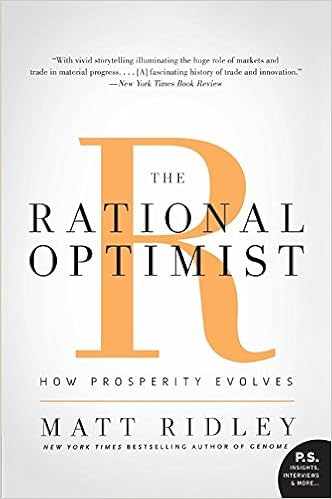
Book Review: Rational Optimist by Matt Ridley


I haven't read Matt I haven't read Ridley's other books though his Genome book has been in my radar for a while. Picked up his 2011 book "The Rational Optimist: How Prosperity Evolves", on a whim. While browsing shelves in a book store, this title attracted my attention. He does a nice job of building up his argument to leave us feeling pretty optimistic about the rest of our lives.

His main thesis is that contrary to what the media and conventional wisdom will have you believe, we are not nearing a tipping point after which the civilization as we know is going to collapse. This is applicable to famines, population explosion, wars, global warming, lack of fossil fuels and so on. He argues that human beings have mastered trade and it distinguishes us from the rest of the species on this planet and it is our path to salvation, quoting economist Herb Gintis who ran the Ultimatum Game among different tribes and said, "Societies that use markets extensively develop a culture of co-operation, fairness and respect for the individual". 

First chapter of the book titled "A Better Today: The Unprecedented Present", does a wonderful job of running through a large number of the facets of life showing how things have improved over time. He first starts off with a family living in medieval times that people often claimed lived a simple easy life and points out how absurd that concept is since they struggled just to get enough food to survive, which may be contaminated in all sorts of way, suffered from diseases, died young, fought the elements, had to be worried about rulers, neighbors, wild animals and so forth. He then goes on to argue that every aspects of the human life we can examine ranging from deceases, income, inequality, length of life span, range of products available, travel, to more egalitarian social structures, the needle has been moving in the right direction quite fast in the past century or two. He acknowledges the growth of income inequality in the last couple of decades in countries like US and UK. But brushes them aside saying if you consider the entire world trends rather than individual pockets, still the direction is positive. He does concede that changes may not be uniform and steady allover the world but is consistently positive when we look at the long term trends. 

I have heard of a study describing how much light one can buy for average wage for an hour worth of work. Since light can be considered a luxury than a necessity like food for living, this is an interesting measure. He discusses this study in detail. In monetary terms, artificial light used to cost 20,000 time in 1300AD England compared to today! If we go even further back, in 1750BC an hour's labor could have bought 24 lumen hours (sesame oil lamp) compared to 186 lumen hours in 1800AD (tallow candle), 4,400 in 1880 (kerosene lamp), 531,000 in 1950 (incandescent light bulbs) and 8.4 million today (compact fluorescent bulb)! In other words, an hour of work today earns us 300 days worth of reading light while even couple of hundred years back in 1800AD it would have got us only 10 minutes! Just one measure of the age of abundance we live in. He then points out as to how the Louis XIV at Versailles in 1700 ate dinner each night alone, choosing from among 40 dishes prepared by some 498 people served in gold and silver plates. This may sound like an extraordinary amount of wealth (that was made possible by keeping the 498 servants and many more in poverty) not available to us in our wildest imagination. But if we really think through, a working mom on her way home can go to the grocery store and pick the dinner she wants for her family choosing from much more than 40 choices. Chances of contamination are also lot less than what the kings in those days had to put up with. Certainly, those aisles and aisles of offerings in the super market are not exclusively for us. But what difference does that make? In the author's point of view all this became possible because we learned to accumulate our knowledge, specialize in what we do best and trade our goods and services. Even if one side benefits much more than the other side in a transaction, it didn't matter since both sides are better off in the end than trying to be totally self-sufficient.

After a very good start, book becomes a drag in the middle where author is discussing the manufacture of virtue in the 50,00 years of human history, farming 10,000 years ago, and the triumph of the cities 5,000 years ago. Though the historical connotation is important to this thesis, the narrative really gets boring to be picked up again on the last 1/3rd of the book. He points out repeatedly as to how environmental & charity organizations along with the media have an inbuilt need to highlight bad news to keep people engaged and to get the societies and the governments to keep them well funded. If news and research reports are positive, no one is going to watch the TV or make donations to organizations. There are lots of discussions about lying through or cherry picking statistics to present dire/bleak pictures. 

My notion that typical (but certainly not all) American authors don't know and don't bother to learn much about  that one third world country over there full of Hindis who speak Hindoo :-), got a bit of reinforcement from the other direction in this book. Ridley, who is a British author, had even more to say about India compared to China. Beyond the discussions related to Mohenjo Daro & Harappan (today's Pakistan region) civilizations, he also used India (and Africa) in examples explaining how without central Governmental control and guidance, people will adopt latest technologies they find useful to make their lives better. In early 1997 economist Robert Jensen documented how fishermen in Kerala, a Southern coastal state in India, struggled to sell their sardine catch each day as they had no idea which town in the 20 mile coastal stretch had the demand. Later that same year with the advent of mobile phones, as they were sailing their boats back to the coast, they started making phone calls to various coastal markets and landed in the one that offered the maximum price for their catch. Apparently the result was that the fishermen's profits increased by 8 percent while simultaneously the sardine prices to the consumer fell by 4 percent and reduced the wastage from more than 5 percent to practically zero!

He argues that even the two biggest areas garnering pessimism in the last two decades, development of Africa and global warming are not well founded in reality but is based on selected statistics and anecdotal evidence. I won't go as far as he recommends in getting rid of government regulations and supporting unfettered trade everywhere since anything pushed to an extreme doesn't work well and some level of moderation is needed. For example, Somalia has negligible governmental regulation compared to US but can't be held high as the model to follow. But I certainly subscribe to his ideas such as all the dire models talking about us running out of fossil fuels or population explosion collapsing our civilization, presume no technological change or course correction anywhere even in future, which when added to the models may show that the future may not look so bleak. 

Decent read, if you can slog, skim or skip through the middle chapters. Bill Gates, who disagrees with Riddley in very similar ways as I do, has posted a nice balanced review of this book on his blog site that is worth reading. Let me know what you are reading. If you are receiving this mail, you owe me at least one email a year. :-)
-sundar.  

Friday, July 18, 2014

ஒரிஜினல் உச்சரிப்பில்…

First published at Solvanam.com on July 1, 2014
KalkiGroup
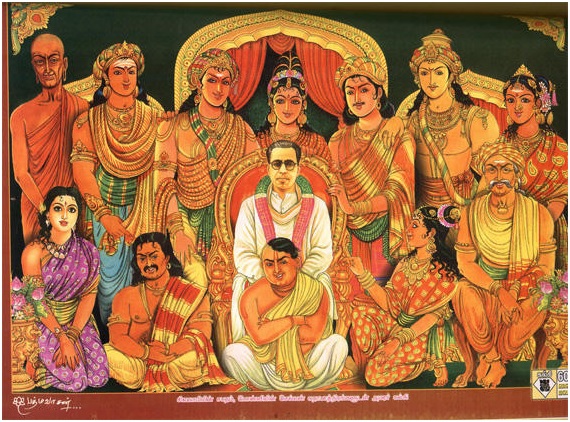
கல்கியின் பொன்னியின் செல்வன் நாவல் சமீபத்தில் சென்னையில் மேடை நாடகமாக அரங்கேற்றப்பட்டு, பெரும் வரவேற்புடன் ஓடி முடிந்து வேறு சில நகரங்களை நோக்கிப்பயணித்து இருக்கிறது. தோட்டா தரணியின் மேடை அமைப்பும், தேர்ந்த நடிக நடிகையரின் உழைப்பும், மொத்தமாக குழுவினரின் ஈடுபாடும், அவர்கள் பட்ட சிரமமும் சேர்ந்து கல்கியின் புதினத்தை வெகு அழகாக மேடையேற்றி இருப்பதாக ரசிகர்களும் பல பத்திரிக்கைகளும் பரவசப்பட்டு இருக்கிறார்கள்.
ஏறக்குறைய அறுபது வருடங்களுக்கு முன் கல்கி இந்தத்தொடரை எழுதியபோது கதை மாந்தர்களான வந்தியத்தேவனும், ஆழ்வார்க்கடியானும், குந்தவையும், நந்தினியும் எப்படி இருந்திருப்பார்கள் என்று வாசகர்கள் புரிந்து கொள்ள உதவியது மணியம் அவர்களின் கற்பனை வழியே நமக்கு கிடைத்த ஓவியங்கள். இன்னும் ஒரு படி மேலே போய் யோசித்தால், கதை நடைபெறுவது என்னவோ ஒன்பதாம் நூற்றாண்டில் இருந்து பதின்மூன்றாம் நூற்றாண்டு வரையிலான சோழர் காலத்தில். அப்போது ஆழ்வார்க்கடியானும் அருள்மொழிவர்மனும் வந்தியத்தேவனும் நந்தினியும் பேசிக்கொண்ட தமிழ் எப்படி ஒலித்திருக்கும், என்னென்ன வார்த்தைகளை பேச்சு வழக்கில் உபயோகித்திருப்பார்கள் என்பது எல்லாம் கல்கிக்கே வெளிச்சம். தமிழ் உச்சரிப்பை பொறுத்தவரை ராஜா ராணி காலத்து கதை என்றால் நமக்கு பொதுவாக ஞாபகத்துக்கு வருவது ராஜராஜசோழன் போன்ற படங்களில் நடிகர் திலகம் பேசும் வசனங்கள்தான். அவை அழுந்தந்திருத்தமாகவும் இலக்கண சுத்தமாகவும் இருப்பது வழக்கம். நவாப் ராஜமாணிக்கம், R.S.மனோகர் போன்றவர்களின் புகழ்பெற்ற நாடகக் குழுக்கள் சரித்திர நாடகங்களை மேடையேற்றிய போதும் அவர்கள் பேசிய பண்டைய தமிழும், வசன உச்சரிப்பும் அதே பாணியில்தான் இருந்தன. பத்து நூற்றாண்டுகளுக்கு முன் காலத்து தமிழை கேட்டால் நமக்கு அது தெளிவாகப்புரிவது மிகவும் சந்தேகம்தான். ஆங்கிலம் அளவுக்கு தமிழ் மொழியும் உச்சரிப்பும் மாறவில்லை என்று மொழியியல் வல்லுனர்கள் சொல்கிறார்கள் எனினும் கல்கி ஏதோ நமக்கு புரியும் தமிழில் எழுதிய கதையை நமக்கு தெரிந்த வரலாற்று பாணியில் பேசி நடித்து மேடை ஏற்றி மகிழ்ந்து கொண்டு இருக்கிறோம்.
RRCholan
பத்து நூற்றாண்டுகளுக்கு முந்தைய தமிழை இப்போது மேடையேற்றுவது கடினம்தான். ஆனால் வெறும் நான்கு நூற்றாண்டுகளுக்கு முன் ஷேக்ஸ்பியர் நாடகங்கள் எழுதி அப்போதே அரங்கேற்றிய போது அவருடைய வசனங்களை அந்தக்காலத்தில் எப்படி பேசி இருப்பார்கள்? இந்த யோசனையில் மூழ்கிய சிலர், இங்கிலாந்தில் ஷேக்ஸ்பியர் காலத்து உச்சரிப்புடன் இப்போதும் அவரது நாடகங்களை நடத்த முடியுமா என்று முயன்று கொண்டு இருக்கிறார்கள். நமக்கு சிவாஜி போல் ஆங்கில உலகிலும் சர் லாரன்ஸ் ஒலிவியே போன்ற புகழ் பெற்ற நடிகர்கள் வசனங்கள் பேசிய விதம் சரித்திர நாடகங்களில் எப்படி வசனங்கள் பேசப்பட வேண்டும் என்பதற்கு இன்றும் முன்மாதிரியாக இருந்து வருகிறது. 1948ல் வெளிவந்த ஹாம்லெட் படத்தில் To be or Not to be, that is the question என்கிற வசனத்தை நிறுத்தி நிதானமாக மிகவும் தெளிவான உச்சரிப்பில்தான் அவர் பேசி இருக்கிறார். கேட்டுப்பாருங்கள். ஆனால் ஷேக்ஸ்பியர் காலத்தில் அந்த வசனத்தை “Tuh beh oar nat tuh beh” என்பதுபோல்தான் பேசி இருப்பார்கள், அதுவும் வெகு வேகமாக என்று இப்போது ஊகித்து இருக்கிறார்கள். அப்படியானால் ஹாம்லெட், மெக்பெத், ரோமியோ, ஜூலியட் எல்லோரும் ஷேக்ஸ்பியர் காலத்திலேயே மேடை ஏறி உலவியபோது எப்படிப் பேசி இருப்பார்கள்? வேல்ஸ் பல்கலைக்கழகத்தை சேர்ந்த பேராசிரியர் டேவிட் கிரிஸ்டல் இந்த ஆராய்ச்சியில் நிறைய ஈடுபாடுள்ளவர். பிரிட்டிஷ் நூலகம் இவரது உதவியுடன் நடிகர்களை அந்தக்காலத்து உச்சரிப்பில் ஷேக்ஸ்பியரின் பல முக்கியமான வசனங்கள் கவிதைகள் போன்றவற்றை பேசச்செய்து, சுமார் 75 நிமிடங்கள் ஓடும் ஒரு ஒலிப்பதிவாக வெளியிட்டிருக்கிறது. அவரது மகன் பென் கிரிஸ்டல் ஒரு நாடக நடிகராகவும் இருப்பது வசதியாகப்போய் இருவரும் இணைந்து லண்டனில் உள்ள க்ளோப் தியேட்டரில் கடந்த பத்து வருடங்களாய் ஷேக்ஸ்பியர் நாடகங்களை ஒரிஜினல் உச்சரிப்பில் நடத்த உதவி வருகிறார்கள். உச்சரிப்பு என்பது காலப்போக்கில் மாறுவது சகஜம், அதில் தவறொன்றும் இல்லை என்பதால், ஒரிஜினல் என்பதை இந்தக்கட்டுரையைப் பொறுத்தவரை அசல் என்று புரிந்து கொள்வதற்கு பதிலாக மூலமுதலான என்று புரிந்து கொள்ள வேண்டும்.
நானூறு ஐநூறு வருடங்களுக்கு முன் ஆங்கில உச்சரிப்பு எப்படி இருந்தது என்று துப்புத்துலக்க மூன்று உத்திகளை கையாளுகிறார்கள். முதல் உத்தி ஷேக்ஸ்பியரின் 154 சாநெட் (Sonnet) கவிதைகளை ஆராய்தல். சமகால உச்சரிப்பில் இவற்றை படிக்கும்போது முக்கால்வாசி கவிதைகளில் எதுகை மோனை நயங்கள் ஒன்றையும் காணமுடிவதில்லை. எனவே இசைந்து ஒலிக்க வேண்டிய இரண்டு சொற்களில் ஒன்றை தற்காலத்தில் மாற்றி உச்சரிக்கிறோம் என்று அறிய முடிகிறது. உதாரணமாக அவருடைய 116வது கவிதையில் கடைசி இரண்டு வரிகளில் வரும் இறுதிச்சொற்களான proved, loved இரண்டும் உச்சரிப்பில் இசைய வேண்டியவை. இக்கால உச்சரிப்பில் அவை இசையாததால், இரண்டில் ஒன்றை நாம் உச்சரிப்பது ஷேக்ஸ்பியர் காலத்தில் இருந்து வேறுபட்டிருக்கிறது என்று தெரிந்துகொண்டு, வேறு எங்கெல்லாம் இந்த சொற்கள் காணப்படுகின்றன என்று தேடிப்பிடித்து, பழைய உச்சரிப்பில் proved என்பது தற்போதைய ப்ரூவ்டு என்பதுபோல் இல்லாமல் சுருக்கப்பட்டு உச்சரிக்கப்பட்டிருப்பதை கண்டறிந்து, லவ்ட் என்பதற்கு இணையாக பிரவ்ட் என்று மாற்றி நடிகர்களுக்கு சொல்லித்தந்து இருக்கிறார்கள்.
இரண்டாவது உத்தி சொற்களின் எழுத்தாக்கத்தை (Spelling) அலசுதல். ரோமியோ & ஜூலியட்டில் ஃபிலிம் (Film) என்பதை philome என்று எழுதி இருப்பதையும், ஃபிலிம் என்ற வார்த்தையை ஐயர்லாந்தின் சில பகுதிகளில் இன்றும் பி-லோம் என்ற ஈரசைச்சொல்லாக உச்சரிப்பதையும் கவனித்து அப்படியே நடிகர்களின் உச்சரிப்பை மாற்றி இருக்கிறார்கள்.
மூன்றாவது உத்தி அந்தக்காலத்திலேயே சில நூல்களில் வார்த்தைகளை எப்படி உச்சரிக்கவேண்டும் என்று அதிர்ஷ்டவசமாக எழுதி வைக்கப்பட்டு இருப்பதை தேடிப்பிடித்து படிப்பது. உதாரணமாக பேராசிரியர் கிரிஸ்டல் பிடித்த ஒரு பழைய புத்தகத்தில் R என்ற எழுத்தை நாய் உறுமுவது போல உச்சரிக்க வேண்டும் என்று போட்டிருப்பது உபயோகமான ஒரு துப்பு. இப்படி பலவிதங்களில் நோண்டி தேடி ஆராய்ந்து சான்றாதரங்களை ஒன்றோடு ஒன்று ஒப்பிட்டு ஷேக்ஸ்பியர் கால உச்சரிப்பை ஏறக்குறைய 95 சதவீதம் சரியாக பிடித்து விட்டார்களாம்! இந்த ஒரிஜினல் உச்சரிப்பை விடாமல் பயின்றுவரும் நடிகர்கள் Haste Makes Waste என்பதை “ஹாஸ்ட் மாக்ஸ் வாஸ்ட்” என்று உச்சரிக்கிறார்கள்!
1994ல் ஆரம்பிக்கப்பட்ட க்ளோப் தியேட்டர், ஷேக்ஸ்பியர் காலத்தில் நடத்தப்பட்டது போலவே நாடகங்கள் நடத்துவதற்காக என்று அமைக்கப்பட்டது. மேடை அமைப்பு, உடைகள், போன்றவை அந்தக்காலத்தைய முறைப்படி செய்யப்பட்டாலும், உச்சரிப்பையும் அந்தக்காலத்திற்கு கொண்டுபோனால் யாருக்கும் பாதி நாடகம் கூட புரியாது என்று பயந்து இருந்தவர்கள், பத்து வருடங்களுக்கு முன் முதல் முறையாக ரோமியோ & ஜூலியட் நாடகத்தை ஒரிஜினல் உச்சரிப்பில் அரங்கேற்ற, அதற்கு ஏகப்பட்ட வரவேற்பு! ரசிகர்கள் சில உச்சரிப்பு மாற்றங்களுக்கு கொஞ்சம் காது கொடுத்து உன்னிப்பாக கேட்டு பழக வேண்டி இருந்தாலும், வெகு நாட்களாக விளங்காமல் இருந்த பல ஷேக்ஸ்பியர் விகடங்களும், மோனை நயங்களும் திடீரென பலருக்கு புரிய ஆரம்பித்தன! இந்த முறையில் பேசுவது வேகத்தையும் சற்று அதிகரிப்பதால், ரோமியோ & ஜூலியட் நாடகம் சுமார் பத்து நிமிடங்கள் சீக்கிரமாக முடிந்து விடுவது இன்னொரு ஸ்வாரஸ்யமான பக்கவிளைவு! வரவேற்பு இன்னமும் தொடர்ந்து கொண்டு இருப்பதால், சாதாரண உச்சரிப்பு மற்றும் பழைய உச்சரிப்பு என இரு விதங்களிலும் நாடகங்களை தொடர்ந்து பல இடங்களில் நடத்தி வருகிறார்கள்.
உலகில் வாழும் மக்கள் தொகையில் பாதிப்பேருக்கு ஒழுங்காக குடிதண்ணீர் கூட கிடைக்காதபோது இந்தமாதிரி ஆராய்ச்சி எல்லாம் தேவைதானா என்று ஒரு கேள்வி எழலாம். ஆனால் இந்த பழைய உச்சரிப்பில் நடத்தும்போது, சாதாரணமாக ஷேக்ஸ்பியர் நாடகங்கள் எல்லாம் உயர்தர வர்கத்து மக்களின் பொழுதுப்போக்கு என்று வெறுத்து ஒதுக்கும் பலர் வியந்து வந்து “அட, அங்கங்கே நம்மளைப்போல் பேசறாங்களே!”, என்று பார்க்கிறார்கள். எப்போதும் ஷேக்ஸ்பியர் நாடகங்களை பார்க்கும் ரசிகர்களும், அவற்றில் நடிக்கும் நடிகர்களும் ஒரிஜினல் உச்சரிப்புடன் நாடகங்கள் நடத்தப்படும்போது, கழுத்துக்கு மேலிருந்து தலையை உயர்த்திக்கொண்டு பேசுவதுபோல் இல்லாமல் இதயத்தில் இருந்து நடிகர்கள் பேசுவது போல உணர்கிறார்கள். தவிரவும், நடிகர்-ரசிகர் இடையேயான தொடர்பு இன்னும் நெருக்கமானதாக இருப்பதாகவும் சொல்கிறார்கள். நல்ல கலைகள் நாலு பேருக்கு பதில் நாற்பது பேரை போய் சேர்ந்தால் நல்லதுதானே? பொன்னியின் செல்வன் நாடகத்தை சோழர் கால உச்சரிப்பில் நடத்தும் காலம் விரைவில் வரட்டும். தமிழ் ரசிகர்கள் நிச்சயம் வரவேற்கக்காத்திருப்பார்கள்.
படங்கள்: நன்றி விக்கிபீடியா, தேமதுரம், மற்றும் பல வலைதளங்கள்.
oOo