Sunday, January 3, 2016

Book Review: Capital in the 21st Century by Thomas Piketty

Read Capital in the 21st Century written by this French Economics Professor named Thomas Piketty over the last one month. I should mention that the book was originally written in French and has been translated into English by Arthur Goldhammer whom I heard speaking well on an NPR interview. Quality of his translation and perhaps the original writing itself is quite good that the flow, prose, tempo and information density of the book remain consistent throughout this tome. Depending upon the eReader font/page size, this could appear as a 700 to 900 pages long book and so may not be for everyone. But I thoroughly enjoyed reading it and would recommend it.

Piketty argues that the rate of return capital produces (r) is invariably more than the rate of growth of the economy (g). When this r > g status continues for long periods of time, the importance of capital increases creating a "rentier" class that becomes richer and richer simply by holding on to capital while the segments of the population that depends on their labor to generate income is permanently put on a disadvantage making them poorer with no real path/opportunity to catch up. This wealth inequality leads to conditions where the wealthiest 1% of the population (top centile) often disproportionately receives >20% of the nation's income, while the wealthiest 10% (top decile) takes away >50% of the income/wealth, leaving the bottom 50% with just about 10% of income. 

He marshals in volumes and volumes of data that is analyzed in detail (lots of Excel generated charts :-) to bring these points out over time (over hundred years) and space (France, US, UK, Japan, Sweden being the countries analyzed the most). He can't appreciate enough about the quality of probate records available for analysis in France and complaints about how little data is available from countries like China, India and Russia. There is hardly any analysis of African countries for the same reason. But his conclusion is that analyzing data from these rich countries clearly spells out as to how the rise in inequality will continue unless governments take concrete steps to arrest this trend. 

Book is segmented into four parts. Parts 1 titled Income and Capital & 2 titled The Dynamics of the Capital/Income Ratio covers all the basics of economics one needs to know to understand the rest of the book. Part 3 titled The Structure of Inequality dives into how the current world is made up of people deriving their wealth mostly through capital and those that get paid for their labor and how the inequality gets magnified between the two classes. On the labor side, there are these super managers (CEOs of MNCs) that get paid absurd amounts of money. He points out well as to how the increase in margins of productivity brought about by these CEOs can never really be that high to match the salary they draw and how often they get enormous raises when factors totally outside their control increase their company revenue or stock price. Then he digs into the capital side with even more vigor to show that capital that usually provides 5% annual return while the growth of the mature economy average only about 1%, people holding capital can live a very comfortable life and still reinvest most of their profit to keep building up their wealth endlessly. Only during the two world wars capital actually got decimated correcting this trend. Now that the world wars are long past, we are back to the normal mode where the inequality trends higher and higher. 

He points out as to how France and UK used to be more inegalitarian in early parts of the last century compared to US. But during the last 30 years this trend has changed considerably making US one of the most inegalitarian states in the world. In US there is a general sense ensconced in the collective conscious that inequality is a prerequisite to entrepreneurial dynamism. It is contrasted with Europe which is denounced as a poster boy of socialism that is a sanctuary to Soviet style egalitarianism. But letting this trend to continue will be devastating to the overall wellness of the society. So, what is his prescription to address the issue? On part 4, he suggests a small progressive tax on capital, say 0% on wealth less than 100K Euros, 0.2% for the band between 100K to 1 million Euros and say 0.5% or more above that band. He says this will be similar to property taxes we pay now but will include all kinds of wealth including  bank balances, stocks, mutual funds, real estates, and so forth. He concedes that all the countries in the world sharing their banking data across the world will be a prerequisite to implement such a tax policy. I'd fully endorse such transparency as it can bring in phenomenal changes in the world. He argues that bringing that level of transparency may look daunting initially, successful implementation of FATCA type laws clearly show that it is possible. He sees lot more value in bringing this global transparency than the actual revenue that will be generated by this capital tax, though it won't be anything to laugh about. Since he is not talking about replacing income or estate taxes but complimenting them with capital tax, it does make sense. Countries like Sweden are moving in that direction already. My main worry will be how effective will governments be in properly collecting and spending so much more money. I think being in Europe where there are several small countries (Nordic & Scandinavian countries comes to mind) with homogeneous population, similar values, small but rich economies and good technology manage to run high tax/high government services model well supporting a very egalitarian setup might push one to think that the same model could be extended to the whole world. In reality in large countries with diverse population with varying values and technology, it may be much harder to implement. But as he argues, though it may sound utopian, trying to move in that direction might be better than not trying at all letting the inequality continue to build up towards some eventual societal explosion. 

On a side note, he talks about Bill Gates' wealth and how is portrayed in the US media as the poster boy for reaping rewards for good work and how he should be allowed to accumulate any amount of wealth while contrasting his with current richest man in the world, Carlos Slim and previous richest men from Japan who are portrayed by the US media as shady characters that got their wealth via unacceptable illegal monopoly and due to some lucky real estate investments respectively! I do notice such media biases allover the world. Anyway, Bill Gates maintains a blog site where he talks about the books he reads and has appreciated this book and has even discussed the book via Skype with Piketty. You can see his write up here:

Bill Gates argues that consumption should be taxed instead of wealth. But Piketty doesn't think that is a good idea for multiple reasons. Measuring consumption is even more difficult, making the tax burden progressive will be very tricky and it will impose larger tax burden on the poor again. There are lot more discussions on how arbitrarily drawn national boundaries make countries rich/poor due to availability of natural resources (oil, minerals), how the implementation of the stateless currency of Euro across Europe has to be quickly followed up by fiscal, political integration of Europe without which the whole system will unravel and so forth, that I found persuasive. It is always good to see works that comprehensively analyze data over large periods of time (this one starts from Belle Époque and spans into the recent great recession) and explain trends in similar scales instead of over reading small ups and downs occurring in short time periods in specific markets and extrapolating them to make global predictions. I was quite amused by all the literary references in the book (Jane Austin's Sense and Sensibility makes multiple appearances) to explain how in previous centuries idle living using the income generated from large estates is considered the most respectful. He is able to develop lot of ideas using pointers available in old novels as to how much income one needs to get from their wealth (usually 100 times the national average) to live a comfortable life. 

I picked up the hardcover edition from the local public library few months back. But since it was a new book, I could get it only on a two week loan. As you could imagine, I had to return it unfinished as there were holds on the book preventing me from renewing it. But during this Dec/Jan season, our local library is undergoing renovation and so I could check it out for two months. So, jumped on it. Though I read the hardcover edition, since I liked the book and found the eBook on the web for $4.99, bought a copy as well. Buying an eBook reminded me of an article I read about this particular book. Amazon & Google are able to track how far people get to by looking at their bookmarks and what page numbers quotes used in book reviews come from. Apparently not very many get past the first 100 pages. :-) 
-sundar.

Thursday, December 31, 2015

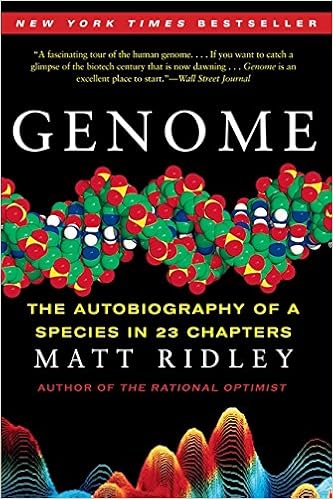
Book Review: Genome by Matt Ridley


I remember reading a long while back that if Newton had not explained gravity, someone else would have. This doesn't take away the credit for his contribution but means that such important things cannot go too long without being addressed by someone. I felt that the book "Genome - The Autobiography of a Species in 23 Chapters" by Matt Ridley falls into that categoty. It is a piece of work that was just sitting there for someone to locate and pull it out. I wish I had written it myself. :-) 
The human DNA and genome is often incorrectly described as a blueprint for life. Actually each part of a blue print precisely defines how one part of a building needs to be constructed. Though there may be some general definition, individual parts of a blue print has no systemic relevance and the same blueprint is not repeated in every part of the building over and over either. So, looking at DNA as a book of life makes more sense. Once you do that, writing a book with 23 chapters, with each one describing something relevant to one chromosome nicely follows. The author had done a neat job of putting this elegant idea to work, identifying one characteristic gene/quality representing each one of the chromosomes and writing about all its manifestations in that chapter. 
First chapter is aptly titled Life, discussing what is a life form (something that can replicate itself and bring order) and how a filament of DNA contains the recipe for making life forms. He talks about the simplicity of the language of DNA itself with just four alphabets (A, C, G and T) and how the genes in the little finger of our hand are direct descendants of the first replicator molecules from an unbroken chain of billions of copies over millions of years! Next chapter dives into how somehow in their digital language the genes that are almost identical between humans and chimpanzees tell the foot of a human fetus to grow into a flat object with a heel and a big toe, while the same gene in a chimpanzee tells it to grow into a more curved object with less of a heel and longer, more prehensile toes! 

Subsequent chapters dive into history, fate, formation of diseases like cancer due to mutations, really neat discussion on how different parts of the human body gets formed just once in the right order/location correctly as the foetus grows, how telomere copying puts a limit on longevity, cures for diseases, and concludes with discussion on eugenics and free will. In the 22nd chapter discussing eugenics, he points out as to how all the countries in the world including US, Sweden, Germany passed and promulgated eugenics laws to prevent certain sections of the population from breeding. Perhaps being a Britisher, he then gets glib glossing over details to claim how "sanity prevailed in Briton" alone where no such laws were passed! He himself has pointed out as to how most of the material for eugenics came from Britannia and quotes people like Churchill who advocated the use of X-rays and operations to sterilize the mentally unfit insisting the "curse would die with them". In the next page he does correctly points out as to how amniocentesis is used in countries like India to about fetuses of girls with no additional equivocation. How would it sound if I glibly announce that sanity prevails in India based on anecdotal evidence that my own sister as well as many of my close friends have only daughters?!
One quality that puzzles me with most books of this kind is the total absence of any illustrations/photos anywhere! Decades back adding figures in books might have added considerable production cost. This book itself is ~15 years old. But even now most of the books we see don't seem to carry any drawings. In my limited technical writing experience, I always find adding illustrations extremely useful in making materials of this kind more accessible. I looked around the web for reasons that will preclude inclusion. But couldn't find anything meaningful.
Though there is no special gene for free will, last chapter does a nice job of bringing the screen down on the whole narration discussing nature vs nurture and how one influences the other. Many of my friends have read this book a long time back. I am catching up finally. If you haven't, do give it a go, after watching YouTube and Khan Academy videos for quick visual primers on the topics of genes, chromosomes and DNA so that you are all set to digest and enjoy the material as you read through.
-sundar.

Wednesday, October 21, 2015

Book Review: Adapt by Tim Harford

I found "Adapt: Why Success Always Starts with Failure"  by Tim Harford a delightful read. It was given to me as a present by a friend. I initially looked at it a bit askew, imagining it to be a pure business management book. But found the material very engaging, covering a wide variety of topics from Iraq war to Broadway plays with hardly anything specifically preachy about running a business.

I think the drab title does a bit of disservice to the book. I remember reading as to how "What they don't teach you at Harvard" wouldn't have been such a best seller if it had been correctly titled as "Few useful management principles" reflecting its true content. This is a case in reverse that could have used a more creative title. :-)

The opening chapter lays out the thesis arguing that nothing turns up perfect and spectacular right on the first time and so we should be ready to experiment while being fully aware that many of the experiments will fail. Then when failures occur, recognize and get out before the loses mount and try again. He points out that even biological evolution is perfecting life only through enormous number of trial and error where most of the trials end in errors that get purged out. Next chapter talks in depth about the Iraq war, how the then Secretary of Defense Donald Rumsfeld refused to learn from failures on the ground and how couple of specific commanders in field that ignored directions from the top and implemented their own local strategies that finally turned the war around. He then moves on to discuss how such skunk-work efforts eventually turn out to be game changers by citing the example of Spitfire plane design in Briton that affected the outcome of WWII by being lot more nimble compared to humongous bombers that were considered the main reason a side will win the war. I am sure there are lot of other books out there that will exclaim how Spitfire like projects became so effective and successful. But they usually argue that those that were behind them were extraordinary geniuses that could see the clear path to victory that others couldn't. I am always skeptical of such books/views since they ignore the fact that 95 out of 100 such efforts will end in failure. In Homer Simpson's words, "Trying is the first step to failure". :-) What I liked about this book is its recognition that while most will be failures, as long as we structure the system such that the failures won't result in any catastrophe, we can learn to ignore them and move on to try something else without feeling emotionally spent. 

In subsequent chapters author covers the recent financial meltdown, climate change, micro financing, etc. The prose is pleasant and the analysis is not pedantic that makes it an easy but engaging read. Towards the end there are discussions about Google (where employees are allowed to try their pet projects most of which fail while very few turnout to be spectacularly successful), Wholefoods, Timpson retail chains, W. L. Gore (that developed Goretex) and other such organizations that employ different types of localized, flexible strategies that seem to work for them, of course with the right level/kind of oversight so that employees are not swindling the company without doing any work. Last chapter talks about Twyla Tharp & Billy Joel's collaboration that produced the Broadway musical "Movin' Out" that was a total failure when it launched in Chicago first. Tharp being a reputed dancer/producer was willing to take in the criticism (instead of claiming how her genius is not understood by those silly critiques), worked on fixing all the issues and turned it around to create a hugely successful show by the time it came to Broadway. Some of these points could be easily acceptable in abstract. But on a daily basis I do see how people are not willing to accept criticism and change themselves or their work. I try hard not to belong to that club. :-)

Book is an academic lite type since it is a fun read. Still packs in lot of interesting material and analysis, while not sounding like a cliched management book. Give it a shot.
-sundar.

Sunday, September 27, 2015

Book Review: Stiff by Mary Roach

While browsing the community public library aisles came across this book called Stiff: The Curious Lives of Human Cadavers. I had heard about it ~10 years back and so it piqued my curiosity. It easily turned out to be the most morbid book I have ever read! The author Mary Roach being a journalist, book had an easy to read feel to it. It is not hard to comprehend but packs quite a few interesting facts/angles in its 300 pages. 

She starts off the first chapter with an onsite reporting of a CME (Continuing Medical Education) type seminar where plastic surgeons practice their face lifting skills on cadavers. This makes perfect sense since physicians that are training to be surgeons in their residency often learn the trade on the job by assisting board certified surgeons operating on real patients that doesn't leave much room for error. They initially start off with closing sutures and move up stage by stage to doing the surgery themselves under more experienced surgeon's supervision. You can immediately see the value in getting trained on cadavers where you can make all the mistakes you want to acquire the knowledge/skills you need. But the morbidity streak starts on the first chapter itself as she gets into the details of how the training is provided not on full cadavers but just using human heads that have been separated from their bodies and the details of the separation process. Still a gentle start. Next chapter dives into body snatching and other tales from the dawn of human dissection. Since dissection wasn't an allowed practice by the church and there were weird promulgated laws that defined the confines of where/when such research can take place, there were a lot of black market trading/work that went on. Body snatching from graves was a very profitable business for grave diggers themselves in those days!

Next four chapters were the most educational as they dive into so many types of research that won't be possible but for the help provided by cadavers. As the author writes in the acknowledgements section, researchers working on cadavers don't want to be on the spotlight since their work is often and very easily misunderstood and their research funding is invariably very vulnerable to negative publicity it tends to attract. But we need to salute the kind of work that gets done in these areas in one of a kind places. Take the vaguely named Anthropological Research Facility that is part of the University of Tennessee Medical Center outside Knoxville. I heard about this facility on the radio just couple of months back. They study the decaying process of cadavers under varying conditions and publish detailed reports. These conditions include dry, wet, humid, buried, underwater, shallow/deep graves, car trunks, inside concrete, mud, plastic wraps and every other scenarios criminals all over the world might have thought of! Without these studies forensic analysis of murder victims can never be as accurate as it is these days to help nab the culprits. An ORNL (Oak Ridge National Lab) team is working with them to develop an electronic nose that can smell the body and tell you when the person died. Findings like barring extreme temperatures, corpses lose 1.5 degree Fahrenheit per hour until they reach the temperature of the air around them, if the unique volatile fatty acids/compounds of human decay are not found in the soil, the body had been moved and so forth can not be added to our forensic science knowledge base without this work. 

Next chapter talks about cadavers being used in automobile crash tests to first assess what level of force inflicts which type of injury on human beings. While we never hear about this research on the media or car advertisements, the crash test dummies that are often shown in safety test videos come later. Those dummies measure how much force was in play in various crash conditions to be compared to what a human being can withstand based on previously completed cadaver tests! Following chapter talks about what data you can gather from dead bodies found in plane crashes. If a bomb had been exploded from a plane toilet, you'd see burn marks on the fronts of the people sitting right behind the toilet. On the otherhand, if you see burn marks on the back of floating bodies in the sea, it might be from burning fuel that caused the mark after death as dead victims will usually be lying face down on water. 

There is a chapter on tests done to assess the impact of bullets/bombs on victims. This is again very sensitive as relatives like to hear that their dead relative's body was used for organ donation rather than being used for shooting practice. So, even though gathered information could be quite useful, wherever possible researchers use gelatin like substitutes that is also easy for studying exit wounds as the artificial substance is clear (i.e. no need to do surgery to understand what happend inside) and can be reused. One chapter that touches upon embalming was also detailed enough to give a good view of the process the schools put their students through to prepare them for this trade.

Subsequent chapters, while providing the needed comprehensive completeness of the subject, go into weird and gruesome areas of animal research, cannibalism and the so called religious research related to crucifixion. If you read the book and happened to be queasy, you can skip chapters 7 to 10 to save yourself some trouble. Last chapter gets back into alternatives for burial/cremation discussing water reduction and composting of human bodies that are more eco friendly! If you have seen the Body Works exhibit that is making the rounds around the world, the plastination treatment used to produce those exhibits are also covered. If case if you are interested this YouTube video has a quick primer. :-)

Perhaps since the material might be off putting to lot of readers, the author intentionally finds/maintains a sense of humor throughout the book. Though it wasn't disrespectful in anyway, it still felt a bit a odd. But one can understand it from a defense mechanism point of view for the treatment of this subject. 

One heck of an unusual, peculiar, unorthodox book!
It reinforced my conviction that when I die, donating all my useful organs and allowing my body to be used for medical research is the right thing to do.  I already have it recorded in my Last Will and Testament. Do you? 
-sundar.

Saturday, September 19, 2015

Book Review: The Billion Dollar Molecule by Barry Werth

I have been meaning to read books related to biology since I am not deeply in touch with that field on a daily basis. So, after checking with a good friend in the biomedical industry for suggestions, ordered three books. Finished reading the first one called "The Billion-Dollar Molecule: One Company's Quest for the Perfect Drug" by Barry Werth. It is a 20 year old book that tells the story of the formation of a new company called Vertex Pharmaceuticals, created in 1989 as a scrappy upstart trying to compete against the industry Goliaths like Merck. Since the book came out in 1994 itself, it covers only the first 4 years of the company. Within that time frame, it already did IPO and had become a multimillion dollar entity. 

Main character in the narration is Joshua Boger who is an ex-Merck employee that is the founder, President and Chief Scientific Officer for this new pharma start up. Usually big pharma companies used to keep analyzing soil samples, plants, insects and other existing entities one by one in a hit or miss approach to see if any of them can be identified to have useful molecules that could treat diseases. Boger's apparent path breaking idea is to skip that brute force approach and design a needed molecule from scratch. He calls it structure based design. While there is no guarantee that this will promptly result in useful drugs quickly, his assessment was that drugs created using this model will have lot less side effects since they are built to address a specific need rather than picked out from a more complex product and distilled down to form a drug that may still have lot of residual effects that can manifest into undesirable side effects. Other reason is designing drugs in this fashion could cost a lot less (and so will be suitable for a scrappy start up). Though the idea makes sense in theory, constructing the molecule this way is not easy since you may not even know exactly what is it that you want to begin with. 

The team takes up an experimental drug called FK-506 that belongs to a Japanese company. While the drug's efficacy in immunosuppresant therapy appeared good, it was also found to be highly toxic in several animal study. So, Vertex took it up to improve the drug by redesigning the needed molecule retaining the needed therapeutic effects sans toxicity. Initially for more than a year company tries to to understand the molecular structure of FK-506 to determine how it works as an immunosuppresant drug. As the race goes on, towards the end the Vertex team fails in it attempt as a competing academic discloses the structure and the mechanism as to how it works. Vertex with a few last minute somersaults manages to get its paper also published on the Nature journal to claim co-credit and victory. Around the same time they also start working with the British drug maker Burroughs Welcome to develop a protease inhibitor to address HIV & AIDS and eventually develop a compound called VX-478 that performs better than competing one from Merck. While these research efforts are in progress in their labs (in Massachusetts), Boger runs around Wall Street to get funding for the start up, makes deals with companies in Japan, Europe to get more money, share credit for research, line companies up as collaborators who will manufacture the drug when the Vertex research bears fruit. While the outside world may normally think that serious research work is done in calm, quiet environment with people dedicated to science, book talks about instances where this company scientist and other academics rush to meet Nature & Science journal deadlines to get a paper out with a date stamp to claim credit for their discoveries, push prestigious journals like Nature to re-examine their decision to reject a paper and eventually accept it, how in conferences scientists jockey for positions/credit and so forth.  

The author probably understands the science involved very well and so describes the work glossing over a lot of the details or doesn't understands the details and so is not able to explain them well. Being an outsider, I didn't find the science described well to understand it properly. There are more than a dozen second line characters that appear in the book. Many are described as geniuses but what they they do is not clearly described. To me, other than Boger, many of the characters overlapped each other due to the fuzzy nature of the narration and so I had a hard time remembering each one's important contribution or role. Since the book is ~430 pages long, each time I crossed about 100 pages, I tried to see what was effectively communicated in the previous section. Other than the general notion that a small start up is trying to create drugs, not much else stands out. When I cross another 100 pages and don't seem to have learned anything new, I start wondering how did the last 100 pages get filled up!

Perhaps since I have lived through the dotcom boom and bust, reading this book now doesn't seem to give any extremely new insight as the overall story unfolds very similar to what happens in tech startups. If I had read it in the mid-90's it might have appeared eye opening. Just two decades late, I guess! In the end Vertex (VRTX) seems to have done well. While its IPO in the early 90's was at $12 with its initial market cap hovering around 60 million dollars, its stock is at $127 now fetching with it a market cap of 31 billion dollars! Saw reports that it is the undisputed leader now for drugs to treat Cystic Fibrosis. 

While there are often books, movies, and documentaries about how some little start up managed to hang on by its nails then grew to become a huge multi billion dollar behemoth, I find stories in the opposite end of the spectrum more interesting. There was a documentary I saw a while back called Startup.com. During the dotcom boom era the documentary producer got permission to record developments as a small tech company called GovWorks.com started building its service, working with several local municipal governments in the US. Their business model is to develop a web portal to collect local property tax, income and other taxes, parking fines, speeding tickets, etc., deliver it as a contracted service to the local government and public and take a cut from the money collected for the service provided. It was a novel idea at that time. Even now there is no single portal you can use to pay for local government services as each municipal office maintains its own portal. The documentary maker's goal was to record how this idea becomes a company, does IPO and makes everyone involved a multimillionaire. But as the dotcom bust occurred, this company wasn't able to get enough local governments to sign up for their services and as the funding starts to dry up, the two friends who originally start the company become enemies. The one who became the CEO, calls the other guy who becomes the CTO, not good enough to keep leading the company. The CTO sues the company, heating things up. Finally the whole company craters and is shutdown! While the story might be depressing, that is what happens to most of the new startups. While success stories are needed to keep motivating people to take the jump, failure stories are also needed for us to learn the lessons. I hardly see them being told in the media of any kind!

Picked up Genome by Matt Ridley next. Will see how it fares.
-sundar.

Saturday, May 30, 2015

Book Review: The New Digital Age

I have been reading this 250 page book called "The New Digital Age: Transforming Nations, Businesses, and Our Lives" for a while now. In between took up two other books and wrapped them up! Finally finished it today guess mainly because I have this OCD tendency to complete reading all the books I pick up. Now that I am done, I am trying to recall what new ideas I picked up and nothing much comes to mind! This is sad.

Book is written by Eric Schmidt and Jared Cohen and came out two years back. They both have interesting backgrounds. Schmidt was the CEO of Google from 2001 to 2011 and is currently the Executive Chairman of Google. Cohen is the Director of Google Ideas and Senior Fellow at the Council on Foreign Relations, etc. With this background, I thought they will deliver extremely insightful views on how the the digital revolution is/will change the world. They have put together some six chapters all of which are titled as "The Future of xyz", with xyz replaced by States, Revolution, Terrorism, Conflicts, Reconstruction, etc. These are all interesting areas to explore from the Digital Age perspective. But there is no new vision or insight anywhere to be found. If you have been watching the news, reading magazines over the last decade, you'd know pretty much all the superficial things they have stated. Occasionally some parts where they are talking about isolating parts of the cyberspace that are contaminated into quarantine (similar to what we do in real-world to isolate terrorism sponsoring national entities or spread of a disease), issuing digital visas to visit parts of the net in future, etc. might be new/interesting to some readers or policy makers. But I had a hard time finding many such examples. They also have played it very safe so that they are not angering US Govt (they are against WikiLeaks, etc.) that might jeopardize their own future careers. Might be a good idea from their personal career point of view but it makes the book read more like a US Govt report rather than an insightful analysis of outsiders.

I guess enough said. I will keep it short this time. :-)
-sundar.

Book Reviews: Innovator's Dilemma & Jugaad Innovation

Few weeks back when we went on a week long vacation, I packed "Jugaad Innovation - A Frugal and Flexible Approach to Innovation for the 21st Century" by N. Radjou, J. Prabhu & S. Ahuja as a possible lite read. When we were leaving for the airport from my SIL's home after a bit of repacking, I couldn't locate the book. Since I figured it didn't make sense to head out without any reading material, grabbed "The Innovator's Dilemma: When New Technologies Cause Great Firms to Fail" by Clayton Christensen from my SIL's home book shelf. By the time we boarded the plane, located the first book as well. This turned to be a blessing in disguise since both books were of the lite variety and were quite related to each other in their content. So, before the vacation was over, I could read the older Innovator's Dilemma (ID) first and then finish more than half of the Jugaad book that dove tailed into the first one nicely. Whenever I saw book reviews on The Economist magazine that often discussed two books together, I used to wonder how they found two different books that came out around the same time that are so closely related. Used to brush that thought aside thinking that topic must be the current fad inspiring multiple people to write books. Though these two books were published more than 10 years apart, serendipity had me reading them back to back in the same week. So, here I am talking about them together.

The ID book is more than 17 years old and is sort of a classic since the thoughts put forth in the book were new in the late 90's. By now the ideas are part of the common business wisdom. But are still plausible threats to existing large businesses. Main ideas presented can be summed up in these three bullets:

  • Often when disruptive new ideas or technologies bring in new products to market, customers using older products won't know what to do with the new products (since they may not match their present needs nicely). But the other advantages such as cost, portability, ease of use may help other customers pick it up. Once the market grows, the cheaper, newer alternative can eat into the main market.
  • Established companies who pay all the attention to existing customers taking care of all their needs with evolutionary products may miss this change in the market place and may end up on the side lines while new companies move in and start eating their lunch.
  • Established companies should not try to manage this dilemma by trying to do both old and new products with one set of development & marketing teams since the messages/market may be contradicting each other. Instead, they should establish a subsidiary or a standalone group with its own development, marketing teams and P&L center. If the idea succeeds, it can eventually be mainlined.
About one fourth of the book talks about hard drive development by famous tech companies in the 60's to 90's and how despite having the right new product that is quite different from the current crop of products, those companies repeatedly failed to capture the market losing out to new comers. This is due to the fact that the new products are of no interest to their existing customers. For example, a much smaller and cheaper drive that is is slightly slower may not be of interest to the top end computer maker. So, the drive maker puts this product on the shelf and goes back to making incremental improvements to their existing form factor drives to suit the needs of the their customers, as they were taught to in the business school. But a new company starts selling the smaller, cheaper, slower drives to a totally new market such as game consoles. As their sales volume increases, they manage to make the drives faster and thus eat into the high end market due to lower price and smaller form factor. 

Author spends so many pages and charts to convey this idea. While all the charts and tables are important for his analysis, I am not sure it contributes a lot to the book's message. A good editor could have trimmed it down considerably. He then moves on to point out similar slips occurring in very different industries such as earth moving equipment manufacturers. Overall idea is certainly quite important for large enterprises. I was quite amused to see the last chapter where the author discusses how automobile manufacturers should handle the vexing problem of developing and marketing an electric car. Based on all the ideas discussed in the book, the author suggests developing a cheap car, and finding a market that can use a slow car that will drive only about 100 miles between recharging which may take hours. But in the last ten years, Tesla Motors has been doing very well by designing high performance electric cars that drive 300+ miles between charges and are extremely expensive! 

That takes me to the Jugaad book. A friend of mine bought this book as a present to my son when we were in India one year back. It came out only in 2013 when the idea of Jugaad had been raising rapidly becoming a course in Harvard Business School, being talked about as Frugal Engineering by characters like Carlos Ghosn (Nissan CEO) and so forth. In Hindi, the term means improvising something cheap to take care of the local need. 

The three authors have provided a large number of examples and case studies illustrating how R&D conducted in economically poorer societies to develop products and services to meet the local needs have been making tremendous progress in bringing costs down despite being high quality products. These products are then sold back to affluent societies as well! This is very different from last century's model of taking an expensive product with bells & whistles developed for richer societies and then stripping it down to make a cheaper version for poor countries. Often such stripped down versions don't even work well in the targeted markets since the atmospheric conditions, usage models are all quite different compared to the original markets. 

In general most well known consumer products (cars, phones, food items, medicines, appliances) or even industrial products (heavy equipment, MRI machines) & services (banking, manufacturing) that we usually hear about  seems to be coming out of the US or Western Europe companies. So, one might be easily lead to think that other nations such as India don't seem to do much of innovation. This books dispels that myth pointing out to all the new products and services that are being developed and sold in countries like India, Brazil and China at often less than one tenth of the price making them affordable to not only local communities but also to poorer countries around the world first and then to US and Western Europe's affluent societies next. Examples range from an infant baby warmer (a simpler model developed by a woman pediatrician in India that costs <$100 vs. $3000 model sold by GE) to selling solar panels not as a product but more as a service in Brazil. Authors have tried to break down the Jugaad idea into 6 steps, such as 

  • Seek opportunity in adversity: e.g. http://www.mitticool.in/ that is selling refrigerators that work without electricity.
  • Do more with less: e.g. An Argentina farmer that invented the idea of asset light farming to overcome difficulties in owning land, equipment, labor needed for farming and is able to scale this model up now.
  • Include the margins, meaning bring in the resource poor consumers who still need various products and services by making them extremely affordable, easily available using existing infrastructure.
  • Think and act flexibly, meaning get early models out in the open and be ready to change the product/business model if the first idea fails. Doing this early/quickly limits losses.
  • Keep it simple
  • Follow your heart, since strict focus group study and ivory tower R&D may not be always right. Innovators living in the actual society/atmosphere where the product is going to be used may have a better understanding of the actual need.

Apparently Western companies such as Phillips, Ericsson, Pepsi, GE, Nissan, etc. are all learning these ideas and implementing them successfully. You can search YouTube with the term Jugaad and can see literally 100s of Jugaad examples. Most of those may look funny and sad at the same time making us realize how people around the world get by with so little so cheerfully. Still, the ideas can be extended to big and complicated projects as well. I remember reading how ISRO (Indian Space Research Organization) just dug a one foot deep trench with a 1KM radius around the launching pad that turned out to be a simple solution to route lot of cables easily while protecting them from the heat of the launching pad. When the Prime Minister of India quipped last year that the Mars probe they launched successfully cost less than what was spent to produce the movie Gravity, I was able to make that connection. :-)

Naturally, variations of this concept is in practice in various societies. (If you haven't heard of a Liter or Light, see this site: http://literoflight.org/#/) But this book particularly being centered on India, with all the numbers listed in Crores (i.e. Indian equivalent of 10 Million) and money in Indian Rupees (instead of US dollars), sounded quite different since I am so used to US being the center of the universe all the time! :-)

In the last chapter, they have managed to cover themselves saying Jugaad is not the next great thing after sliced bread that will eliminate hunger and bring world peace but is a complementary model for R&D that should be part of an organization's overall MO. Authors have setup a website that is supposed to bring all the related material together and is promoted in the book quite a bit. But I found the site quite disappointing when I visited. I also found the innumerable subsection titles that appear once every two paragraph a bit annoying. Still, this book as well as the ID book, both are easy reads and should be worthy of your time if you choose to pick them up.
-sundar.