Saturday, June 25, 2016

Nuclear Fusion

The Solvanam Tamil web magazine site brought out a special issue on Science & Technology recently. I contributed an article on Nuclear Fusion for the issue. The title அணு விவாகம் in Tamil means Atomic Wedding. I used the thread of marriage and break-up throughout the article to discuss pros and cons of fusion and fission respectively. What you see below is the translated English version. I am not sure the metaphors work in English as well as they do in Tamil. But the piece below still conveys the main ideas.


Whether we look at Nuclear Power Plants like the one in Kalpakkam (India) that has been running smoothly generating power for decades or the likes of Chernobyl or Fukushima that ended up causing historically significant  disasters, they are all dependent on Nuclear Fission technology that splits the atom to generate power. Similar to a divorce or the breakup of a family, splitting up an existing atom usually results in a lot of undesirable consequences, that need to be handled correctly. Over the last two years, thanks to the Koodankulam nuclear power plant related protests in India, the bad effects of running nuclear power plants have been discussed extensively on the media presenting both facts and fiction.

But instead of breaking an atom, we can also merge two atoms and generate power out of that process. This technique called Nuclear Fusion can in theory be used to generate electricity as well.


Similar to a good marriage that brings two people together to form a well functioning new family, when two atoms are fused, the resulting side effects are predominantly good ones. Experts working in this area know/understand this fact very well. But since conducting this wedding is not easy, no one talks about it much. Countries like India, USA, Russia, France and others have joined forces and run projects/tests to move this technology forward. There are also research efforts ongoing at the individual nation level to get nuclear fusion to work and behave. Until the late 90’s this field was mostly relegated to academic research hoping for long term returns. There wasn’t much hope to get this working in a practical way to get usable energy out. But due to recent developments in the last decade or two, several small private companies have entered the fray promising to get this technology working soon and thus generating a good bit of money for the investors.

There are many differences between physical/chemical reaction involved in splitting an atom Vs. fusing the nuclei of two atoms. In nuclear fission, heavy elements such as Uranium (235U) are enriched first and then bombarded with the subatomic particle called neutron. The Uranium atom that gets hit this way, breaks up angrily into two smaller atoms called Krypton and Barium. In the process, it will also spit out three more neutrons and a bunch of energy. When those three freed neutrons attack three other Uranium atoms that are nearby, a chain reaction ensues. This will continue until all the available Uranium is depleted. Since each Uranium atom that gets split also emits a lot of energy, if we leave this chain reaction to continue unabated, it becomes a nuclear explosion. This is effectively the idea behind the atom bomb that can destroy a city in seconds. Instead of letting all the freed neutrons attack the available Uranium atoms, if we capture most of them and remove them from the nuclear reactor where this chain reaction is taking place, letting only a very small number of neutrons to remain in play, it reaches “critical” stage, which just means the chain reaction is stable and sustained while not growing anymore. Now the energy coming out of this sustained reaction can be harvested to heat up water, produce steam, that can then turn the turbine in the generator to generate electricity.  

nuclear_fission.jpg
This type of nuclear fission reaction does not take place in the universe naturally. Human beings have to artificially ignite such a chain reaction by breaking up an existing heavy element atom. In order to start the reaction, we also need to mine elements like Uranium hiding deep beneath the earth. When the fission reaction takes place, it also ends up leaving a lot of radioactive residue that will remain radioactive for thousands of years requiring us to manage that toxic (carcinogenic) leftover from the nuclear power plants.

Nuclear Fusion differs from fission in all these characteristics. In fusion, two usually very small atoms are forced to bang into each other under extremely high temperature and pressure condition. When they bang into each other, the nucleus of the two atoms fuse to form a slightly bigger new atom. If we compare the atomic mass of the new bigger atom with the combined atomic mass of the two atoms that combined together, the newer bigger atom will be slightly lighter. The difference in mass, paying tribute to Einstein’s E=MC2 equation, gets converted into a burst of energy spitting out a lot of heat and pressure. That intense temperature and pressure pushes the next couple of atoms nearby to bang into each other continuing the chain reaction.


Unlike nuclear fission, fusion naturally occurs continuously all over the universe. It is this wedding that provides the main source of heat & light in all the stars including our own sun. The light element atoms that usually take part in nuclear fusion are the isotopes of Hydrogen called Deuterium and Tritium. These are not rare to find elements like Uranium that hide inside the earth and had to be dug up through difficult and expensive mining operations before it can be used in fission reactors. Even when the fusion reaction takes place, there is no radioactive material created that had to be safe-guarded for centuries so as not to cause any harm to human beings. There are very few neutrons that emit from fusion compared to fission. As long as we ensure they don’t go around hitting other elements inadvertently, the only byproduct from D-T Fusion reaction is harmless Helium gas that can be safely used to fill up balloons to be given to children. To top it off, the amount of energy generated from fusion is usually four to five times greater than fission!

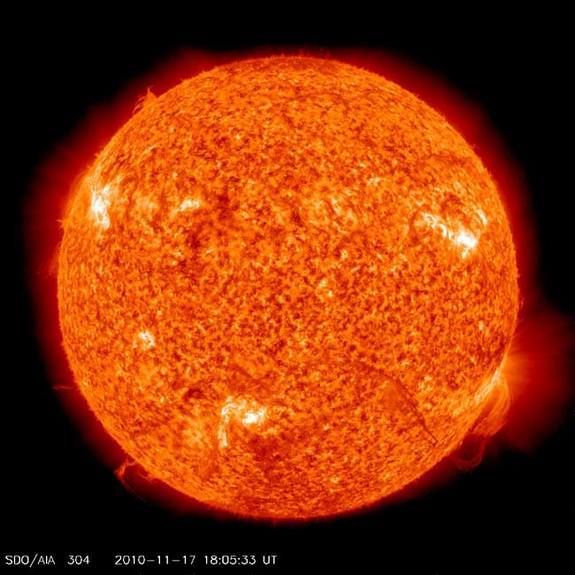
If everything is hunky-dory with fusion, then why are we still using nuclear fission instead of fusion to take care of our energy needs? Answer to that question is the extreme levels of temperature and pressure needed to trigger this fusion wedding. In stars like our Sun, their weight being extremely high, their own gravity provides a means to create the needed pressure. When the nuclear fusion occurs, the heat generated provides the extremely high temperature needed to sustain the reaction. So, there is no dearth of either temperature or pressure to keep the reaction going in the stars.
sun-photo-solar-filament-101118-02.jpg

If we want to get nuclear fusion going on the surface of earth, we need to create similar temperature/pressure working conditions that exists in the stars!  If you wonder if such a thing is even possible, it has already been done in the middle of last century itself. If you had heard of thermonuclear explosion or hydrogen bomb, that is what it was. In those bombs, a regular nuclear fission reaction is initially triggered and then the temperature & pressure generated from that nuclear explosion is in turn used to create a nuclear fusion of hydrogen atoms releasing an order of magnitude more energy. So, we are capable of creating the conditions if it is for exploding a fusion bomb. But under more peaceful conditions when we are trying to use this reaction to generate electricity, exploding a nuclear bomb to trigger fusion is not a good idea. Even after we create the right conditions to trigger fusion, sustaining the chain reaction at the right level ensuring that it neither turns off nor becomes uncontrollable is a big puzzle that has not been fully solved.

To understand how much heat is needed to trigger nuclear fusion we can examine what goes on in the Sun’s environment. The surface temperature in the Sun itself is around 50000 C. If we drill down to the center of the Sun temperature rises to 27 million degrees Fahrenheit (or 15 million deg Celsius)! Sun is also 330,000 times heavier that results in a lot more gravity to create the needed pressure. What goes on in the Sun is an uncontrolled explosion, with a massive amount of hydrogen fuel in play. Since we will be starting the reaction from scratch with limited fuel supply, initially we need close to 100 million degree centigrade temperature to start the reaction.

When Hydrogen atoms are placed in that high a temperature and pressure, they stop being in solid, liquid or gaseous states and switch to a fourth state called plasma. In that state it will vaporize anything that it comes in contact with! So, how do you handle this material safely is another big question perplexing fusion enthusiasts. Since we know plasma reacts to magnetism, current plans envision using massive electromagnetic forces from the instant plasma is formed to handle it safely while simultaneously using it to increase the pressure as well.

In summary, we need to be able to manage two big issues to be able to put nuclear fusion to good use.
  1. First issue is the creation of the needed extremely high pressure and temperature to get fusion going, while delivering Hydrogen atoms as fuel to that location.
  2. Second issue is maintaining the chain reaction well once it is initiated and harvesting the generated energy for use in power generation.  

To find out ways to create here on earth, albeit on a miniscule area, more heat & pressure than what prevails on the surface of the sun, there is a consortium of 35 countries including India and US working together. This consortium is setting up a monster called International Thermonuclear Experimental Reactor (ITER) in the south of France at a cost of twenty billion dollars with a twenty year building plan. For comparison, the other well-known international physics project called the  Large Hadron Collider has a budget that is less than 25% of this one! Do visit this project’s website located here.  

ITER researchers are using the traditional Tokamak based approach to managing fusion. Tokamak is a 1950’s Russian invention that has a huge metal doughnut shaped ring construction that is hollow  inside. By wrapping it up with a lot of coiled wires outside and passing electricity through those wires, we can generate very strong electromagnetic fields inside the ring. Plan is to manipulate this electromagnetic field to control the plasma flowing inside and make it dance to our tune.


This is a monstrous international science experiment and so characteristically, it has blown past all the previously set deadlines and budgets and is crawling along slowly. When the construction is completed around 2027, this is expected to be the world’s largest fusion reactor. Even though it is swallowing massive amounts of time and money, when it finally works, there are no plans to generate electricity to light up nearby homes. There is not even a generator attached to this reactor. Idea is only to master nuclear fusion and generate knowledge for the field.

In parallel, the Lawrence Livermore National Laboratory in US near San Francisco is attempting another approach. The National Ignition Facility being built there is using a setup shown in the next picture. It will take up the space of three football fields and be as tall as a ten story building. Inside the facility researchers are using extremely high powered laser beams that can consume power that is thousand times more than what the entire US consumes at any given instant. These laser beams are blasted onto Hydrogen atoms in very short (couple of nanoseconds) bursts. This approach is termed Inertial Confinement Fusion.


People making fun of this field say, “Nuclear fusion enthusiasts have been claiming that in the next two decades they will master this technology and start producing endless amount of electricity. They have been very consistent over the past five decades and we expect them to be consistent and continue saying the same thing even after another fifty years!”.

But unlike the last century, more people with money and knowledge have started believing that this is possible. So several small private firms have jumped into the fray to make this a reality. We can list multiple companies like General Fusion of Canada, Helion Energy in Washington state, Tri-Alpha Energy that has been in stealth mode hiding in California with good funding and so forth. Few billionaires in US who made their fortunes in the tech industry like Amazon’s Jeff Bezos, Microsoft’s Paul Allen, PayPal co-founder Peter Thiel have pumped in a lot of funding into these companies. Even the defense manufacturer Lockheed Martin (that produces F-16 fighters, and the forthcoming F-35, etc.) has jumped in with a tall promise that they will deliver a nuclear fusion based generator that will fit in the back of a truck in five years! They said it last year and so four more years to go!

Experts that work in these private firms openly say that unlike researchers in national labs and academia, they are not going to be wasting time discussing their findings in conferences and publishing papers endlessly but will focus on getting things to work quickly, won’t analyze why when things start to work, focus on delivering the fruits of their labor to the society at large with the goal to monetize their work similar to the tech industry.


The technical approaches taken by these private teams differ from academic/government teams on multiple fronts. For example, none of the private firms think that building monstrous tokamak is practical for power generation projects. Sinking so much money into building them while the technology remains experimental for decades is not considered economically viable and may push out power generation into timelines unacceptable to private industry. Even the National Ignition Facility’s approach of using extremely powerful large lasers is not considered practical. So, these smaller private firms have been building reactors that are just the size of a house. These smaller reactors use two or more canons that will shoot plasma towards each other that will collide and result in fusion. Tri-Alpha claims that they are able to trigger and sustain the reaction for up to five milliseconds already. Though this is just 200th of a second, in nuclear fusion this is like a decade!
 

Most of the nuclear fusion attempts tend to use Hydrogen isotopes Deuterium and Tritium. Though D-T Fusion are much safer compared to fission reaction, they also emit few free neutrons that need to be captured to make sure they don’t end up hitting other atoms nearby inadvertently leading to any radioactive material. So the Tri-Alpha team is avoiding these isotopes altogether and are instead trying to fuse protons into commonly available element Boron. Though the reaction requires even higher temperature, they don’t seem to think it is a difficult to solve problem based on their experience in the field. Since Boron is an abundantly available element, they joke that when they start selling their reactors, they will come with a lifetime free supply of fuel. No fission reactor manufacturer can make that promise!

Though these firms have started to trigger and sustain the reaction for few milliseconds already, till now the energy spent in triggering/managing the reaction is more than the energy that comes out of it. When the energy spent is equal to the energy released, we will reach energy break-even point.

For this technology to become economically viable for power production, the energy RoI (Return on Investment) need to be fifteen to twenty times more and we should be able to harvest the energy properly! Even when the ITER reactor comes online in 2027, the target is to generate 10 times more energy compared to what goes in. Since that won’t be enough for commercial success, the smaller firms are trying to use much smaller reactors that use very little energy to start/run the reaction. They hope to do it for much less money as well so that in the end the generated energy can easily top the 20x goal since what is going in is orders of magnitude smaller. If their math works out, it will end our dependency on fossil fuel for all our energy needs. In that alternate reality, this field will blossom into a great solution providing endless gobs of cheap energy without spoiling the environment. There is not even a spec of doubt  or should we say even a subatomic particle size of doubt that such a transformation can change the history of entire human civilization. We will hopefully see that change in our lifetime.

---o0o---

Wednesday, April 20, 2016

Book Review: The Emperor of All Maladies by Siddhartha Mukherjee

Author Siddhartha Mukherjee is a practicing Oncologist with an M.D & Ph.D. to boot and has an enviable command of the language. He does a splendid job of comprehensively covering the history, background, pathology and the current status of research in a highly accessible book without dumbing down the details. Though I am not a physician, I believe even people in the field of medicine will benefit from reading this work.

My wife and I were discussing the orthodontic treatment lots of kids go through to get their teeth straightened out. This is mainly done for cosmetic reasons with some clinical value added as well. Despite the thousands of dollars charged, the treatment provided using braces is rather crude as it involves tying your teeth up with metal wires/rods/screws and pulling and pushing them to get them moved to the correct location in your mouth. There are new techniques like InvisAlign that costs even more but are functionally the same. I'd say latest cancer treatment drugs fit the other end of the sophistication spectrum. Though perceived as a single disease by most of the world population, cancer being a family of diseases with a rich sociopolitical, medicinal history warrants a book of this kind.

He starts all the way from Egyptian Physician Imhotep (circa 2625 BC) who described breast cancer precisely with the conclusion that there is no cure for it. As the chapters progress, he discusses Hippocrates' (400 BC) ideas of four fluids (blood, black bile, yellow bile and phlegm) that need to be in good balance for the human body to function properly, Greek physician Galen's (160 AD) thoughts about black bile being the cause of cancer, subsequently Vesalius disputing this idea of black bile in 1540, and then rolling on to Dr. Halsted's radical surgery ideas that became the accepted norm at the turn of the 20th century. Major contributors to the forward movement of the research such as Sidney Farber, the NY socialite Mary Lasker, the Jimmy Fund, Emil Frei & Emil Freireich's (who in the 1960s created the strategy to cure acute Lymphoblastic Leukemia using toxic drugs leading to the idea of chemotherapy), Henry Kaplan (who came up with radiation therapy for Hodgkin's Lymphoma) start making appearances in the middle of the book though the narration is not strictly chronological in order. As time progresses many of the ideas (like radical mastectomy) get questioned leading to combination therapy (e.g. small lumpectomy and chemo combination to address breast cancer), idea of universal cure gets more and more elusive, each president since Nixon promise a lot of money and 10 year target to cure cancer that all fall flat, links to various carcinogen and cancer (e.g. cigarettes, asbestos) gets established. Reconciliation of the three different theories that were thought to be the cause of cancer (retro viruses, chemical carcinogens and genes) and their conflation slowly leads to the realization that cancer needs to be handled from prevention, early detection as well as fine-tuned treatment perspectives together. I liked the big picture that evolves through the underlying meta story illustrating how science progresses in fits and starts while tackling large problems (unlike in Hollywood movies where one problem gets a clear solution developed by one person).
What is most exciting is the rounds of development over the last two decades where the pathology is understood in lot more detail. This effectively leads to the understanding as to how cells at a mutated gene level called oncogenes accumulating the combination of mutations that leads to endless reproduction (as if the acceleration pedal of a car is pressed all the way down), tumor suppressor genes disabled (equivalent to brakes that will prevent runaway accidents in a car disabled) and maintenance genes that are supposed to clean up errors failing, leads to cancer. Exquisitely designed drugs like Herceptin & Gleevac start to address exact cause of specific tumors. Since such targeted solution for specific cancer type works perfectly (HPV vaccine, Judah Folkman's Angiogenesis drugs are all examples), there is often an immediate euphoria saying there has been a breakthrough and “cancer cure” is around the corner. But invariably the enthusiasm gets deflated quickly when the cancer morphs and relapses and/or the developed solution fails to work for any other cancer type.
With the Human Genome project completed around year 2000 giving us the complete map of the normal human genome, now comparing normal genome to the cancer cells to see which gene had what mutation has been a big development leading to the idea of creating the Cancer Genome Atlas that is still ongoing. This is probably thousand times more complicated/difficult compared to the complexity of the human genome project itself. But the increases in computing capacity, knowledge gained so far and other such factors should make this plausible. While getting this clearer picture help the researchers understand what needs to be done, actual work seems daunting due to the explosive combinations that need to be explored to list all the possible mutations for all the different types of cancers with mutations continuing endlessly adding more complexity to the scope of this endeavor. But the current understanding developed by Vogelstein about thirteen different pathways in which cancer can manifest due to multiple gene mutations described in this nice Nature review paper at least places an upper bound on the size of the problem. This whole field is overwhelmingly dominated by the research teams in US, though there is work/trials that go on in Europe and Japan to a much smaller extent. There is even a story about a South African physician who has been presenting some stunning results related to breast cancer treatment using high does chemo & bone marrow transplant in the 90's that all turned out to be fake that is quite disheartening to read.
Correctly solving cancer in many ways resembles solving some issues in the telecommunication world in a much shorter timescale. Just to give an example, for the past six months our team has been struggling to address a customer issue on the other side of the world where occasionally packets (i.e. information being transmitted) get corrupted (like cells becoming cancerous) that can crash the system (people dying). Simply replacing the whole software/hardware to solve this issue is equivalent to sledgehammer approaches of killing all the new cells being formed via Chemotherapy or radical surgery without precisely understanding the root cause of the issue. Since we don't see the packet corruption in our lab testing, our engineers have been patiently sending the customer software patches (equivalent to drugs) and analyzing the logs that we receive back (test results). We are getting close but haven't resolved the issue fully. When we actually find the root cause which is often a combination of factors, it will be equivalent to identifying the set of specific mutations causing a particular type of cancer. Changing a few lines of code in one or more places out of the millions of lines of code in use on the customer equipment should then very precisely fix the issue. Understanding the exact root cause and sending in a perfect fix could give you great satisfaction. Since no lives are being lost and since this get completed over a period of few months rather than a few decades, such debug efforts are uninteresting to the people outside our world. I can also point out all the ways in which these processes are not equal/comparable. But the excitement and satisfaction derived is no less and so I can fully relate & to some extent understand the process of cancer research.
The US television channel PBS had done a six hour documentary (by the famous documentarian Ken Burns) covering the book's material. I saw that too. Since this book is 500 pages long with a lot of material to digest, I took few months to read it and so watching the documentary helped refresh my mind. If you are not going to read the book, I will highly recommend the documentary. But reading the book should provide lot more details that can't be gleaned from the documentary alone. One complaint I had about the book is how the author had glossed over the exponential raise in the cost of cancer treatment. Particularly in the US, where cancer research and treatment is easily in the leading edge, cost is simply sky rocketing since the cost of treatment/drugs is determined solely by the pharma industry without any government imposed price controls. The PBS documentary covers this aspect a little better and also dives into immunotherapy (drugs like Yarvoy making the rounds now) in lot more detail than the book.
While I can understand readers thinking this book is a bit too dense in content for easy reading, I am glad such works are being created. It deserves the Pulitzer Prize it has received. :-)
-sundar.

Monday, February 22, 2016

27 Year Old American Family

On the Solvanam (Tamil) web magazine, there was an article about television shows in the west (U.S. & European). I wrote a follow up Tamil piece to that article. It got published yesterday as the lead/cover story of the latest issue! This is a quick & dirty translation of that article for your enjoyment.
When I watch a movie or a TV show, rather than being a superficial viewer, I try to learn what I can about  the thought/creative process that went into developing the show. This is not in preparation for me to become a movie director or TV show producer in future. I just think understanding background details will help me enjoy the show/movie with more depth. That’s all. Perhaps once I retire, this knowledge will help me write some useless books. But for now being able to enjoy few good shows like Breaking Bad in depth is RoI enough. :-)
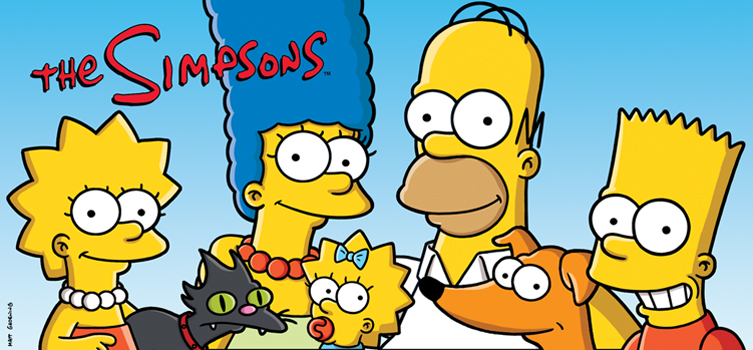
One TV series that should be part of that good shows collection while being a show of very different kind is The Simpsons that has been on the air for the past 27 years on Fox.
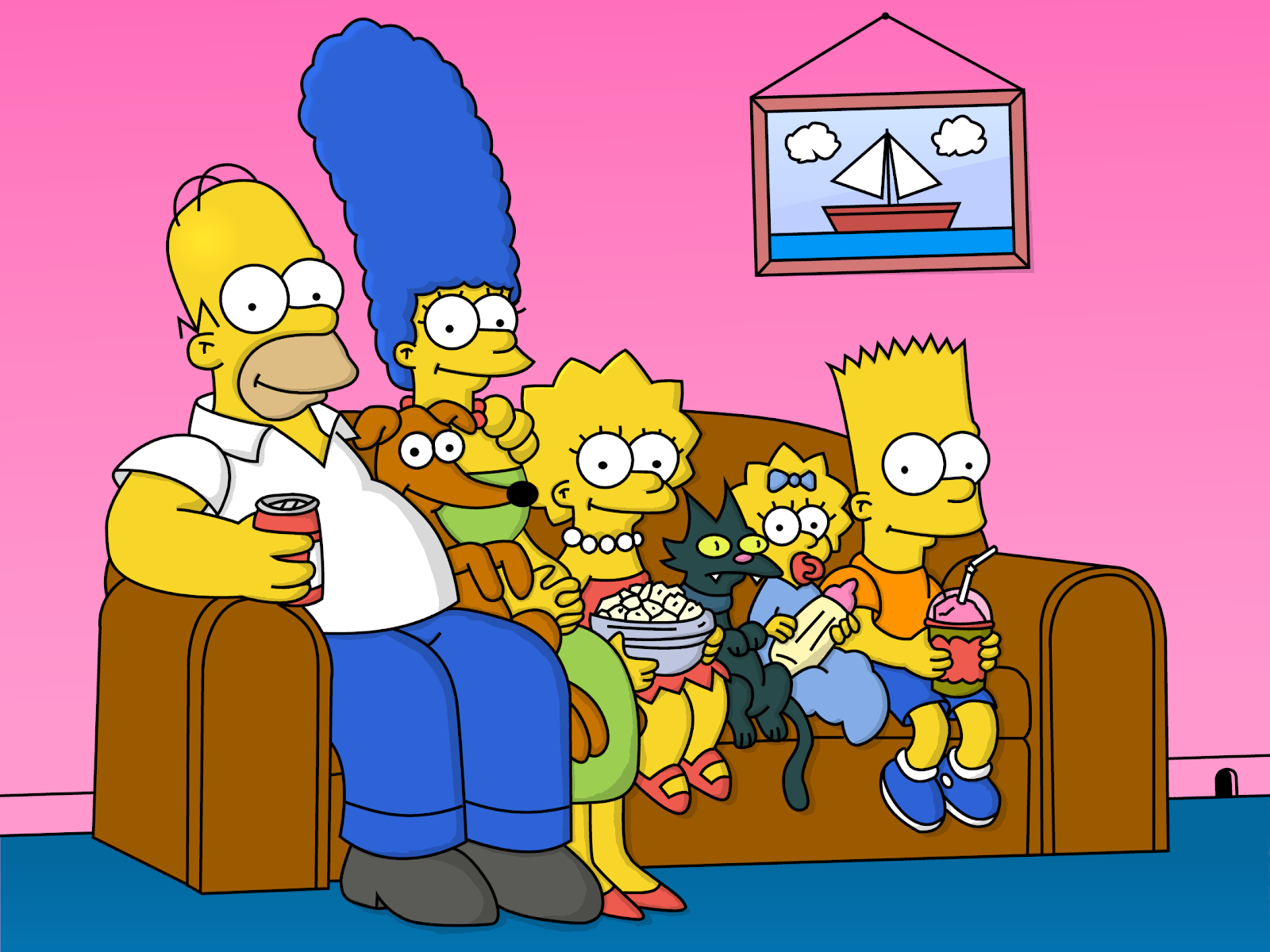
simpsonsfamily
Adults who may not have watched this show closely brush it aside thinking it is a children’s show like Tom & Jerry. You may remember ex-first lady Barbara Bush commenting in the early nineties that it is the stupidest show she has ever seen. That is the height of this ignorance. But the Simpsons show not only laughed aside such silly comments but made fun of the elder Bush and Barbara Bush themselves in one episode and is cheerfully running along till date.   
Serious TV shows like Breaking Bad and Dexter continue to narrate one overarching story without any logical error from episode to episode. So, you need to watch them from the beginning and continue till the end. But Simpsons follows the sitcom model and so each episode comes with self-contained stories allowing a new viewer to watch & enjoy any random episode.  
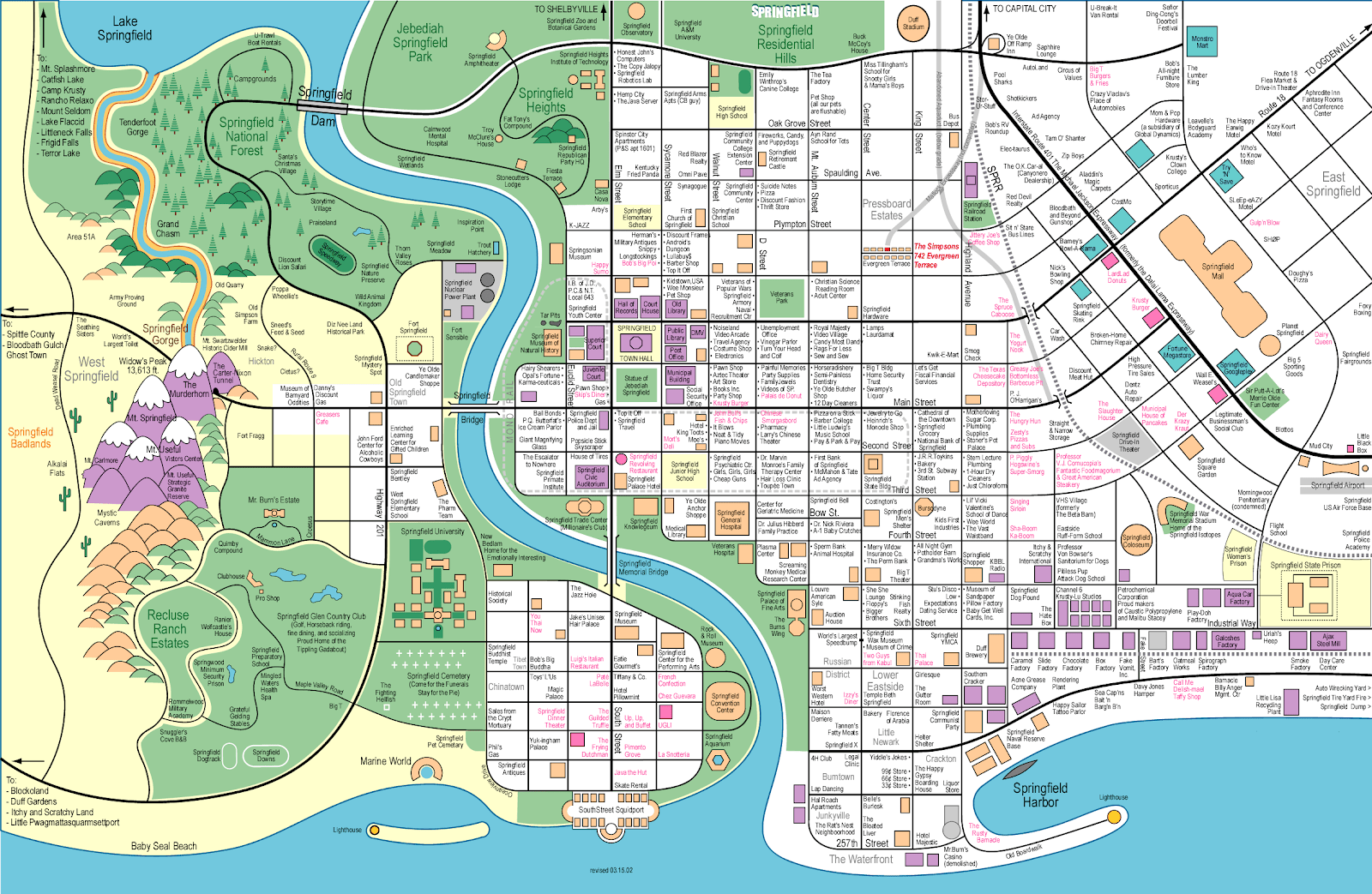
The main characters in this show are the Dad, Mom and the three children forming the nuclear family the show revolves around. They live in a small town called Springfield somewhere in the US of A. The location/state where Springfield is located is never revealed paving the way for so many jokes by itself. This fictional town is similar to Indian writer R.K.Narayan’s Malgudi that forms the backdrop for many of his stories/novels. Though the town is fictional, noting down various remarks & references that have appeared in various episodes, superfans have put together a very detailed map of Springfield that is fun to virtually roam around!
Map_of_Springfield
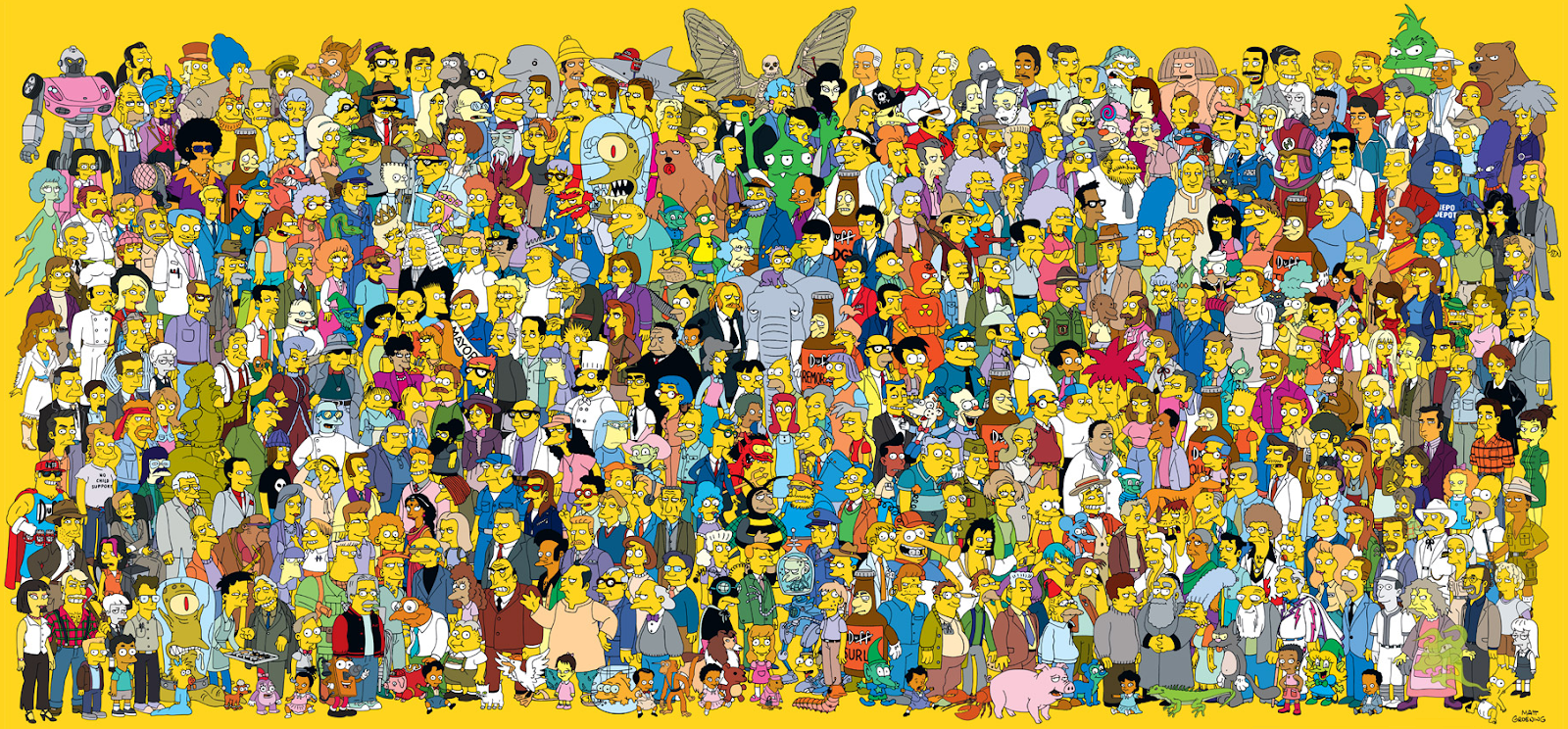
In cartoon shows such as Tom & Jerry, generally there will only be a small set of (single digits) characters. Where they live, their family members and other such details will not be important to the kind of simple stories being told. In contrast, some TV shows like Jetsons and Flintstones that were popular in the 1960’s have tried to create consistent broader backdrops with recurring office, home, small/large story characters and so forth. Simpsons creators have taken this idea an order higher creating a complete universe within the show. Click on the picture below to enlarge it. You will see ~400 characters that have appeared just once or few times or hundreds of times on The Simpsons!
The_Simpsons_characters
A very unique characteristic of the show pioneered by the writers of this show is its layered approach to storytelling. Even a five year old child can enjoy the show watching the brightly colored cheerful looking characters that often do a lot of slapstick comedy. Slightly older teenagers can notice and enjoy how the two or three story threads weaved into each episode nicely blend with each other to form a coherent story line. For the enjoyment of older audience, there are references to American culture, politics, religions, world events, latest technology, sports and so on strewn all over the show with very funny takes.
Writers of this show don’t bother explaining each joke or story detail at length to ensure audience get it. As you learn more and more about the show and the world in general, you will find more and more details hidden in the show waiting for you to discover & enjoy! It is practically impossible to note and enjoy all the details packed inside any given episode when you watch it for the first time. This model encourages fans to watch the same episode multiple times to identify details they missed on their previous watching sessions. Superfans that have caught on to this model have been listing details hidden in the episodes on Did you notice? themed websites for decades! After watching any given episode couple of times, you can visit one of these sites to read & realize how much you have failed to notice yourself despite watching the episode more than once!
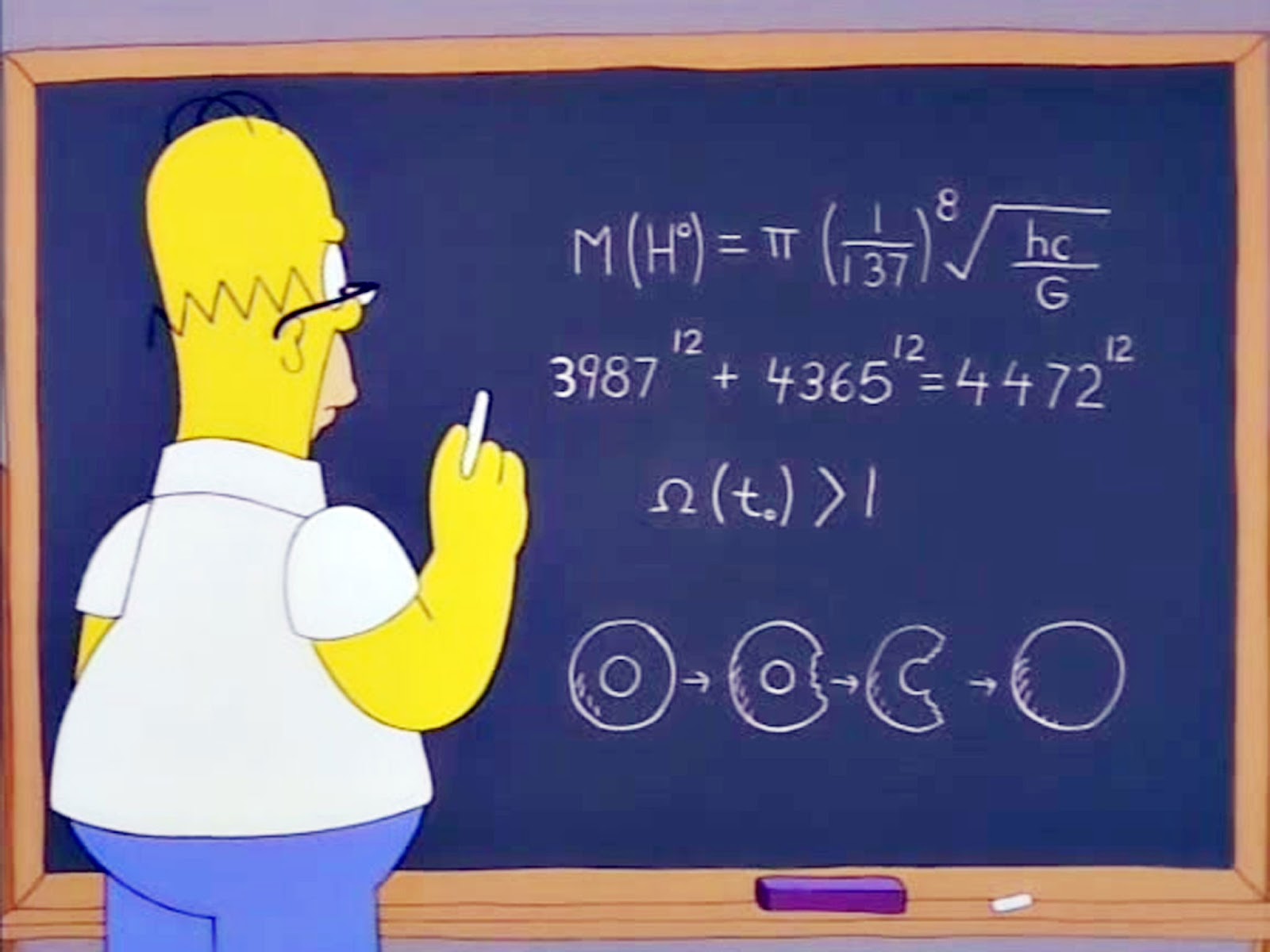
Several books have been written about this show. For example, “The Simpsons and Their Mathematical Secrets” by Simon Singh discusses all the math related details, theories and subtleties that have appeared in various episodes. Let us look at just one example. The Dad in the show Homer Simpson is portrayed as a not so clever dimwit. In one episode, realizing that he hasn’t accomplished anything worthwhile in his life, Homer attempts to become an Edison like inventor/scientist quickly. As a part of that effort, the figure below appears on the show for a second or two.
Homer-Inventor
Scene is designed to make it look like Homer is scribbling down some meaningless numbers/symbols on the blackboard. But take a closer look at the second line alone. In the world of mathematics, the Xn + Yn = Zn equation is quite famous. Everyone remembers the instance where n=2 as Pythagoras Theorem that we encounter in middle school trigonometry. But as per Fermat’s Theorem, that equation does not have whole number solutions when n>2 is well known in math circles. (We can ignore the stories where many lost their hair becoming bald like Homer over 300 years trying to prove it. It is an interesting story in itself discussed here.) If that is the case, then how can 398712 + 436512 = 447212 be true? It will certainly make Fermat’s Theorem false! Even if you plug in these numbers into your calculator, it will come out right forcing you to think perhaps Homer has disproved Fermat’s Theorem! But in actuality this is a near miss solution since the correct answer for that sum is 4472.000000007112 which is way too precise for any of our regular calculators to compute correctly!  Unless we know these details, it is really hard to even notice this joke passing by right in front of our eyes when we watch the show! In fact, the first line on the blackboard talks something equally arcane about Higgs-Boson particle physics! Notice the level of details packed into a seemingly innocent shot that floats by in a jiffy! If such details tickle you, try watching this 4 minute long YouTube video. There Simon Singh explains the math secrets hidden behind 3 different numbers that flash by in another Simpsons episode innocently asking how many people are watching a baseball match in a stadium.
In another episode when the question P=NP? flashed by innocuously in the background of a scene, my friends and I have high-fived each other during my grad school days. If you know of Computer Science Professors, you can ask them about it. They might be surprised to hear you talk about P=NP? if you are not a C.S. major. Writers of the show possessing masters and Ph.D.s in Math, Physics, etc. is one of the reasons for such references popping up everywhere in the show.
You shouldn’t think that these references are limited only to the fields of Math and Computer Science. Two decades back, I came to know about the ancient Egyptian custom of burying a dead royal family member with hundreds of little servant dolls called Ushabtis that are meant to serve them in the next world only through a Simpsons episode!
Man of yester years Mr. Montgomery Burns (owner of Springfield Nuclear Power Plant where Homer works as a safety inspector) always answers the phone in the show with the greeting, “Ahoy Hoy”. It is because that is the appropriate greeting for answering the phone suggested by the inventor of the telephone Alexander Graham Bell! Even though the world has moved on to adapt “Hello” universally, old man Burns is not ready to give up and change! One can keep writing page after page about these nuances. Berkeley and other universities in US have been offering courses centered around this series. For an example, see http://www.sjsu.edu/faculty/wooda/muse/intro.html
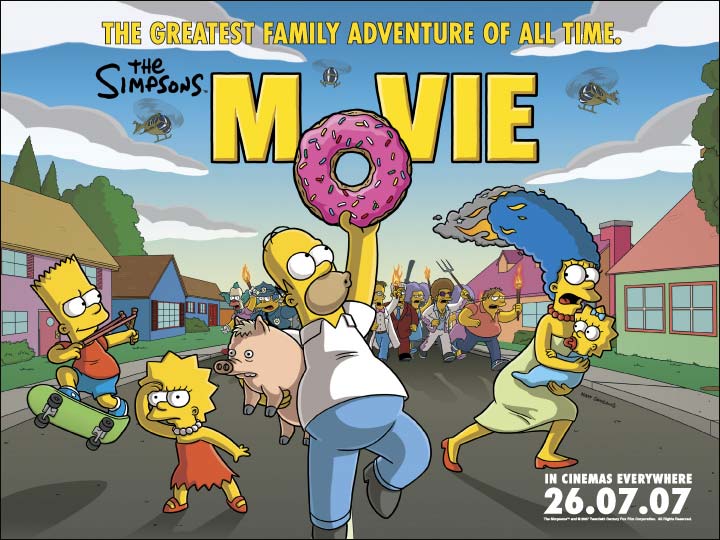
Since this show has been on the air since 1989 continuously, averaging about 20 episodes per year, there are more than 550 Simpsons episodes on the planet. There has been a full length movie as well. During the last year, a new cable channel called FXX has been advertising that they are showing every episode ever created back to back and have done that more than once. Since each episode lasts about 21 minutes, even if they run them without any commercial interruptions, one run will consume more than nine days!  
The_simpsons-movie.jpg
Creators of the show have declared that the characters will not age. So, for the past 27 years Homer has been a 38 year old father, Marge has been a 34 year old mother, Bart & Lisa have been in fourth and second grades in the Springfield Elementary School consistently while Maggie has remained a pacifier sucking baby that never utters a word. Stories are always told as if they occur in the present day. So, the date of birth of characters get adjusted accordingly ignoring any inconsistency with what was said in another episode ten years back. While human beings have five fingers/toes in each limb, evolutionary biologists have argued that logically four fingers (three fingers + thumb) or toes are adequate. As per that notion, all the characters in this show are portrayed as having only four fingers/toes per limb! These are all intentionally introduced illogical paradoxes that have been maintained consistently!
Artists Dan Castellaneta, Julie Kavner,Nancy Cartwright, Yeardley Smith, Hank Azaria and Harry Shearer have been the voices of Homer, Marge, Bart, Lisa, Apu respectively from the beginning of the show. Nancy who does the voice for Bart has even written a book called My Life as a Ten Year Old.   
Starting from India, Simpsons have been to England, France, Japan, Australia, Brazil, Israel, Iceland and even outer space in various episodes. There aren’t that many movies, cultural memes, games, politicians that have not been made fun of in the show. There are also several different experiments that have been tried out including recurring TV show within this TV show, clips of videos that are shown as trailers of a fictional movie that when sequenced form a self-contained storyline, 3D animation, real actors acting/appearing side-by-side with show’s cartoon characters, several dance and song sequences and so forth!
Depending on the storyline, new characters may appear in just one episode and vanish forever. Acting in the show by providing voice for a character is considered an honor by celebrities all over the world. So, starting from ex-British PM Tony Blair, Michael Jackson, Astronaut Buzz Aldrin, Beetles band drummer Ringo Star, Nobel peace prize winner Muhammad Yunus, Prof. Stephen Hawking and other hundreds of celebrities have appeared on this show either as themselves or playing a character. You can see a really long list of who appeared in what episode on this site. Even the crisp dialogs deserve their own mention/appreciation as they have captured the hearts and minds of the audience for decades. Couple of good samples will be Homer’s lines such as “Trying is the first step to failure”, “Alcohol: The cause and solution to all the problems in the world”, etc.
Following the success of this series, Fox itself has created (& cancelled) a slew of similar shows such as Family Guy, Futurama, King of the Hill, etc. Since many of the Simpsons show writers/artists worked on Futurama as well, it had many similarities to Simpsons in the style of drawing, hidden mathematical references and so on. Other TV channels such as Comedy Central have created similar cartoon shows with a lot of consistent background (e.g. South Park). But AFAIK, no other show matches The Simpsons in depth, (though not always) humor suitable for the whole family, continuing quality and the permanence that is successfully leading the show towards its thirtieth year!  
key_art_the_simpsons
In the early 1990’s when I started watching this show routinely, DVDs & Internet weren’t in existence. Since I liked the show, I started recording the episodes as they aired on VHS tapes, manually pausing the tape during commercials to edit them out. Since I was recording in SLP mode, I could fit about eighteen episodes per 2-hr cassette. Since I started the collection this way, despite all the digital technologies that bloomed since then, I stuck to it like Montgomery Burns till 2014, collecting more than 500 episodes in 28 VHS cassettes! I also maintained a spreadsheet listing which episode starts from what minute in which cassette. It was a labor of love. But now, going beyond DVDs, you can watch any episode you wish  from the cloud whenever you want. The days of popping in a six hour long VHS tape in the VCR and watching one episode after another with friends seems to be long gone. Current need seems to be more like searching for a specific two minute clip for a reference, being able to attach it to an email or create a pointer on the web. Since all trends point to this mode being the permanent one in the forthcoming years, people have started writing articles advocating for such distributions. So, about an year back I posted a note on our town’s freecycle.org site saying, “I have this 28 cassette VHS tape collectiion containing 500+ Simpsons episodes. Anyone interested in taking them for free?”. Next day an elderly gentleman stopped by and took away the whole box. I got an email from him after a few days that said: 
I don’t have close family or friends nearby. I am not rich and I struggle with multiple health issues these days. In this situation, the Simpsons collection you gave me gives me very good company, keeping me in good spirits making me laugh all the time. If we had met years back, probably we’d have become good long time friends who share good tastes. Thanks for your gift.
When I finished reading his email, I couldn’t help tearing up. Who said The Simpsons can only make you laugh?
-- o0o --

Sunday, January 3, 2016

Book Review: Capital in the 21st Century by Thomas Piketty

Read Capital in the 21st Century written by this French Economics Professor named Thomas Piketty over the last one month. I should mention that the book was originally written in French and has been translated into English by Arthur Goldhammer whom I heard speaking well on an NPR interview. Quality of his translation and perhaps the original writing itself is quite good that the flow, prose, tempo and information density of the book remain consistent throughout this tome. Depending upon the eReader font/page size, this could appear as a 700 to 900 pages long book and so may not be for everyone. But I thoroughly enjoyed reading it and would recommend it.

Piketty argues that the rate of return capital produces (r) is invariably more than the rate of growth of the economy (g). When this r > g status continues for long periods of time, the importance of capital increases creating a "rentier" class that becomes richer and richer simply by holding on to capital while the segments of the population that depends on their labor to generate income is permanently put on a disadvantage making them poorer with no real path/opportunity to catch up. This wealth inequality leads to conditions where the wealthiest 1% of the population (top centile) often disproportionately receives >20% of the nation's income, while the wealthiest 10% (top decile) takes away >50% of the income/wealth, leaving the bottom 50% with just about 10% of income. 

He marshals in volumes and volumes of data that is analyzed in detail (lots of Excel generated charts :-) to bring these points out over time (over hundred years) and space (France, US, UK, Japan, Sweden being the countries analyzed the most). He can't appreciate enough about the quality of probate records available for analysis in France and complaints about how little data is available from countries like China, India and Russia. There is hardly any analysis of African countries for the same reason. But his conclusion is that analyzing data from these rich countries clearly spells out as to how the rise in inequality will continue unless governments take concrete steps to arrest this trend. 

Book is segmented into four parts. Parts 1 titled Income and Capital & 2 titled The Dynamics of the Capital/Income Ratio covers all the basics of economics one needs to know to understand the rest of the book. Part 3 titled The Structure of Inequality dives into how the current world is made up of people deriving their wealth mostly through capital and those that get paid for their labor and how the inequality gets magnified between the two classes. On the labor side, there are these super managers (CEOs of MNCs) that get paid absurd amounts of money. He points out well as to how the increase in margins of productivity brought about by these CEOs can never really be that high to match the salary they draw and how often they get enormous raises when factors totally outside their control increase their company revenue or stock price. Then he digs into the capital side with even more vigor to show that capital that usually provides 5% annual return while the growth of the mature economy average only about 1%, people holding capital can live a very comfortable life and still reinvest most of their profit to keep building up their wealth endlessly. Only during the two world wars capital actually got decimated correcting this trend. Now that the world wars are long past, we are back to the normal mode where the inequality trends higher and higher. 

He points out as to how France and UK used to be more inegalitarian in early parts of the last century compared to US. But during the last 30 years this trend has changed considerably making US one of the most inegalitarian states in the world. In US there is a general sense ensconced in the collective conscious that inequality is a prerequisite to entrepreneurial dynamism. It is contrasted with Europe which is denounced as a poster boy of socialism that is a sanctuary to Soviet style egalitarianism. But letting this trend to continue will be devastating to the overall wellness of the society. So, what is his prescription to address the issue? On part 4, he suggests a small progressive tax on capital, say 0% on wealth less than 100K Euros, 0.2% for the band between 100K to 1 million Euros and say 0.5% or more above that band. He says this will be similar to property taxes we pay now but will include all kinds of wealth including  bank balances, stocks, mutual funds, real estates, and so forth. He concedes that all the countries in the world sharing their banking data across the world will be a prerequisite to implement such a tax policy. I'd fully endorse such transparency as it can bring in phenomenal changes in the world. He argues that bringing that level of transparency may look daunting initially, successful implementation of FATCA type laws clearly show that it is possible. He sees lot more value in bringing this global transparency than the actual revenue that will be generated by this capital tax, though it won't be anything to laugh about. Since he is not talking about replacing income or estate taxes but complimenting them with capital tax, it does make sense. Countries like Sweden are moving in that direction already. My main worry will be how effective will governments be in properly collecting and spending so much more money. I think being in Europe where there are several small countries (Nordic & Scandinavian countries comes to mind) with homogeneous population, similar values, small but rich economies and good technology manage to run high tax/high government services model well supporting a very egalitarian setup might push one to think that the same model could be extended to the whole world. In reality in large countries with diverse population with varying values and technology, it may be much harder to implement. But as he argues, though it may sound utopian, trying to move in that direction might be better than not trying at all letting the inequality continue to build up towards some eventual societal explosion. 

On a side note, he talks about Bill Gates' wealth and how is portrayed in the US media as the poster boy for reaping rewards for good work and how he should be allowed to accumulate any amount of wealth while contrasting his with current richest man in the world, Carlos Slim and previous richest men from Japan who are portrayed by the US media as shady characters that got their wealth via unacceptable illegal monopoly and due to some lucky real estate investments respectively! I do notice such media biases allover the world. Anyway, Bill Gates maintains a blog site where he talks about the books he reads and has appreciated this book and has even discussed the book via Skype with Piketty. You can see his write up here:

Bill Gates argues that consumption should be taxed instead of wealth. But Piketty doesn't think that is a good idea for multiple reasons. Measuring consumption is even more difficult, making the tax burden progressive will be very tricky and it will impose larger tax burden on the poor again. There are lot more discussions on how arbitrarily drawn national boundaries make countries rich/poor due to availability of natural resources (oil, minerals), how the implementation of the stateless currency of Euro across Europe has to be quickly followed up by fiscal, political integration of Europe without which the whole system will unravel and so forth, that I found persuasive. It is always good to see works that comprehensively analyze data over large periods of time (this one starts from Belle Époque and spans into the recent great recession) and explain trends in similar scales instead of over reading small ups and downs occurring in short time periods in specific markets and extrapolating them to make global predictions. I was quite amused by all the literary references in the book (Jane Austin's Sense and Sensibility makes multiple appearances) to explain how in previous centuries idle living using the income generated from large estates is considered the most respectful. He is able to develop lot of ideas using pointers available in old novels as to how much income one needs to get from their wealth (usually 100 times the national average) to live a comfortable life. 

I picked up the hardcover edition from the local public library few months back. But since it was a new book, I could get it only on a two week loan. As you could imagine, I had to return it unfinished as there were holds on the book preventing me from renewing it. But during this Dec/Jan season, our local library is undergoing renovation and so I could check it out for two months. So, jumped on it. Though I read the hardcover edition, since I liked the book and found the eBook on the web for $4.99, bought a copy as well. Buying an eBook reminded me of an article I read about this particular book. Amazon & Google are able to track how far people get to by looking at their bookmarks and what page numbers quotes used in book reviews come from. Apparently not very many get past the first 100 pages. :-) 
-sundar.

Thursday, December 31, 2015

Book Review: Genome by Matt Ridley


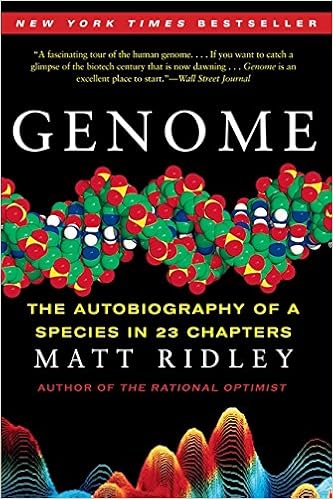
I remember reading a long while back that if Newton had not explained gravity, someone else would have. This doesn't take away the credit for his contribution but means that such important things cannot go too long without being addressed by someone. I felt that the book "Genome - The Autobiography of a Species in 23 Chapters" by Matt Ridley falls into that categoty. It is a piece of work that was just sitting there for someone to locate and pull it out. I wish I had written it myself. :-) 
The human DNA and genome is often incorrectly described as a blueprint for life. Actually each part of a blue print precisely defines how one part of a building needs to be constructed. Though there may be some general definition, individual parts of a blue print has no systemic relevance and the same blueprint is not repeated in every part of the building over and over either. So, looking at DNA as a book of life makes more sense. Once you do that, writing a book with 23 chapters, with each one describing something relevant to one chromosome nicely follows. The author had done a neat job of putting this elegant idea to work, identifying one characteristic gene/quality representing each one of the chromosomes and writing about all its manifestations in that chapter. 
First chapter is aptly titled Life, discussing what is a life form (something that can replicate itself and bring order) and how a filament of DNA contains the recipe for making life forms. He talks about the simplicity of the language of DNA itself with just four alphabets (A, C, G and T) and how the genes in the little finger of our hand are direct descendants of the first replicator molecules from an unbroken chain of billions of copies over millions of years! Next chapter dives into how somehow in their digital language the genes that are almost identical between humans and chimpanzees tell the foot of a human fetus to grow into a flat object with a heel and a big toe, while the same gene in a chimpanzee tells it to grow into a more curved object with less of a heel and longer, more prehensile toes! 

Subsequent chapters dive into history, fate, formation of diseases like cancer due to mutations, really neat discussion on how different parts of the human body gets formed just once in the right order/location correctly as the foetus grows, how telomere copying puts a limit on longevity, cures for diseases, and concludes with discussion on eugenics and free will. In the 22nd chapter discussing eugenics, he points out as to how all the countries in the world including US, Sweden, Germany passed and promulgated eugenics laws to prevent certain sections of the population from breeding. Perhaps being a Britisher, he then gets glib glossing over details to claim how "sanity prevailed in Briton" alone where no such laws were passed! He himself has pointed out as to how most of the material for eugenics came from Britannia and quotes people like Churchill who advocated the use of X-rays and operations to sterilize the mentally unfit insisting the "curse would die with them". In the next page he does correctly points out as to how amniocentesis is used in countries like India to about fetuses of girls with no additional equivocation. How would it sound if I glibly announce that sanity prevails in India based on anecdotal evidence that my own sister as well as many of my close friends have only daughters?!
One quality that puzzles me with most books of this kind is the total absence of any illustrations/photos anywhere! Decades back adding figures in books might have added considerable production cost. This book itself is ~15 years old. But even now most of the books we see don't seem to carry any drawings. In my limited technical writing experience, I always find adding illustrations extremely useful in making materials of this kind more accessible. I looked around the web for reasons that will preclude inclusion. But couldn't find anything meaningful.
Though there is no special gene for free will, last chapter does a nice job of bringing the screen down on the whole narration discussing nature vs nurture and how one influences the other. Many of my friends have read this book a long time back. I am catching up finally. If you haven't, do give it a go, after watching YouTube and Khan Academy videos for quick visual primers on the topics of genes, chromosomes and DNA so that you are all set to digest and enjoy the material as you read through.
-sundar.

Wednesday, October 21, 2015

Book Review: Adapt by Tim Harford

I found "Adapt: Why Success Always Starts with Failure"  by Tim Harford a delightful read. It was given to me as a present by a friend. I initially looked at it a bit askew, imagining it to be a pure business management book. But found the material very engaging, covering a wide variety of topics from Iraq war to Broadway plays with hardly anything specifically preachy about running a business.

I think the drab title does a bit of disservice to the book. I remember reading as to how "What they don't teach you at Harvard" wouldn't have been such a best seller if it had been correctly titled as "Few useful management principles" reflecting its true content. This is a case in reverse that could have used a more creative title. :-)

The opening chapter lays out the thesis arguing that nothing turns up perfect and spectacular right on the first time and so we should be ready to experiment while being fully aware that many of the experiments will fail. Then when failures occur, recognize and get out before the loses mount and try again. He points out that even biological evolution is perfecting life only through enormous number of trial and error where most of the trials end in errors that get purged out. Next chapter talks in depth about the Iraq war, how the then Secretary of Defense Donald Rumsfeld refused to learn from failures on the ground and how couple of specific commanders in field that ignored directions from the top and implemented their own local strategies that finally turned the war around. He then moves on to discuss how such skunk-work efforts eventually turn out to be game changers by citing the example of Spitfire plane design in Briton that affected the outcome of WWII by being lot more nimble compared to humongous bombers that were considered the main reason a side will win the war. I am sure there are lot of other books out there that will exclaim how Spitfire like projects became so effective and successful. But they usually argue that those that were behind them were extraordinary geniuses that could see the clear path to victory that others couldn't. I am always skeptical of such books/views since they ignore the fact that 95 out of 100 such efforts will end in failure. In Homer Simpson's words, "Trying is the first step to failure". :-) What I liked about this book is its recognition that while most will be failures, as long as we structure the system such that the failures won't result in any catastrophe, we can learn to ignore them and move on to try something else without feeling emotionally spent. 

In subsequent chapters author covers the recent financial meltdown, climate change, micro financing, etc. The prose is pleasant and the analysis is not pedantic that makes it an easy but engaging read. Towards the end there are discussions about Google (where employees are allowed to try their pet projects most of which fail while very few turnout to be spectacularly successful), Wholefoods, Timpson retail chains, W. L. Gore (that developed Goretex) and other such organizations that employ different types of localized, flexible strategies that seem to work for them, of course with the right level/kind of oversight so that employees are not swindling the company without doing any work. Last chapter talks about Twyla Tharp & Billy Joel's collaboration that produced the Broadway musical "Movin' Out" that was a total failure when it launched in Chicago first. Tharp being a reputed dancer/producer was willing to take in the criticism (instead of claiming how her genius is not understood by those silly critiques), worked on fixing all the issues and turned it around to create a hugely successful show by the time it came to Broadway. Some of these points could be easily acceptable in abstract. But on a daily basis I do see how people are not willing to accept criticism and change themselves or their work. I try hard not to belong to that club. :-)

Book is an academic lite type since it is a fun read. Still packs in lot of interesting material and analysis, while not sounding like a cliched management book. Give it a shot.
-sundar.